
Homeschooling in Virginia— the four-option state — Notice of Intent and progress evidence due each August.
Virginia gives parents four pathways and four assessment options. The main path: annual Notice of Intent (NOI) by August 15, evidence of progress by August 1 of the following year. Four parent qualification routes (diploma, VA license, curriculum, or adequate ability). Four end-of-year evidence options (standardized test, evaluator letter, college transcript, or superintendent-approved alternative). Below-stanine scores trigger a probation year. Lightstead's VA profile tracks the cadence and stages the evidence packet.
What Virginia requires, at a glance.
- Notice
Aug 15 · annually
Annual NOI to division superintendent by August 15, listing subjects and qualifying option.
- Days / hours
Not specified
Statute is silent on instructional days or hours. The annual evidence of progress is the proof artifact.
- Subjects
Listed in NOI
Subjects are listed in the NOI but not state-prescribed. Parent picks scope, sequence, and curriculum.
- Assessment
4 evidence options
Std test (composite ≥ 4th stanine / 23rd %ile) · evaluator letter · college transcript · superintendent-approved measure.
- Pathway
4 options
NOI (main path) · Religious exemption · Certified tutor · Private school enrollment.
- Teacher qualification
4 options
HS diploma+ · VA teacher license · curriculum/study program provision · evidence of ability to teach adequately.
- Evidence deadline
Aug 1 (following year)
End-of-year evidence of progress submitted to superintendent by August 1 of the year after the academic year.
- Below stanine
Probation 1 year
Composite below 4th stanine triggers 1-year probation; second below-stanine year can require enrollment.
§1
Pick your qualification route — file by August 15.
Virginia requires an annual NOI to the division superintendent by August 15. The NOI names the children, lists subjects to be taught, and selects one of four parent qualification options: (1) high school diploma or higher, (2) current VA teaching license, (3) provision of a curriculum or program of study, or (4) evidence of ability to provide adequate education. Most VA families use option (1) or (3). Option (3) — provision of a curriculum — is satisfied by purchasing or developing a structured curriculum and naming it in the NOI. Option (4) is rarely needed but provides a safety valve when the other three don't fit.
Va. Code § 22.1-254.1(B)
The VA NOI wizard walks through the four qualification options, pre-fills your children's data, and outputs a PDF ready for the superintendent. The August 15 deadline shows on Today's dashboard from August 1 onward.
VA NOI wizard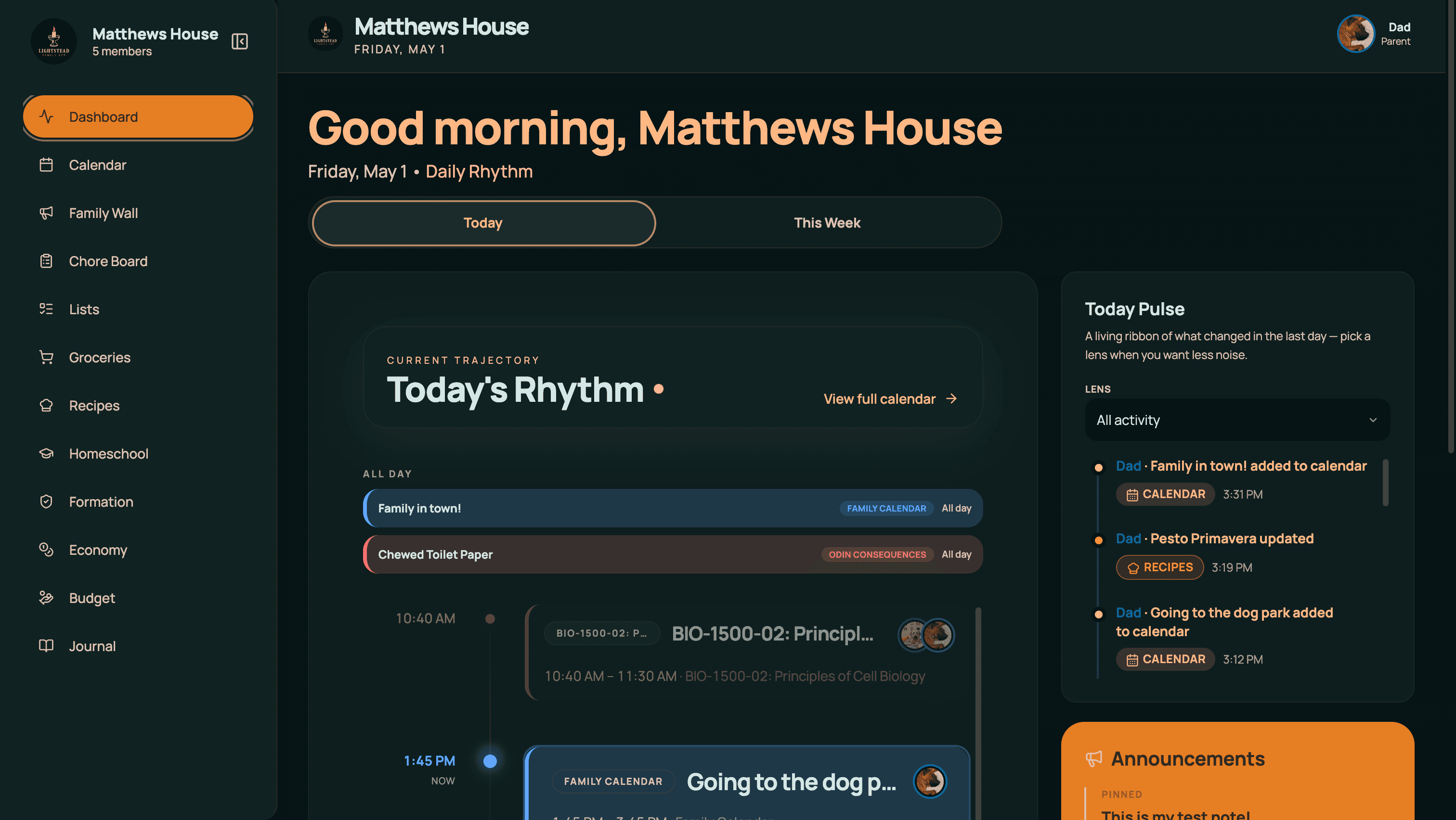
§2
Four ways to prove the year worked.
By August 1 of the year following the academic year, the family submits evidence of progress to the division superintendent. Four options under § 22.1-254.1(C): (a) nationally-normed standardized test, composite at or above the 4th stanine (23rd percentile) — ACT, SAT, PSAT all qualify; (b) evaluation letter from a state-licensed teacher or a person with a master's degree or higher in an academic discipline; (c) college or community college transcript or distance-learning report card; (d) any other assessment the superintendent determines shows adequate progress (requires prior discussion). Most families pick (a) or (b). The 4th-stanine threshold is generous compared to NY's 33rd percentile — a child performing close to grade level satisfies. Below-stanine scores trigger a 1-year probation; the probation year's evidence must show adequate progress.
Va. Code § 22.1-254.1(C)
The evidence packet pulls together whichever option you picked — test scores, evaluator letter, or transcript — into a single PDF for the superintendent. Lightstead shows the August 1 deadline on Today's dashboard from July 1 onward and flags below-stanine scores with the probation handling steps.
Evidence of progress packet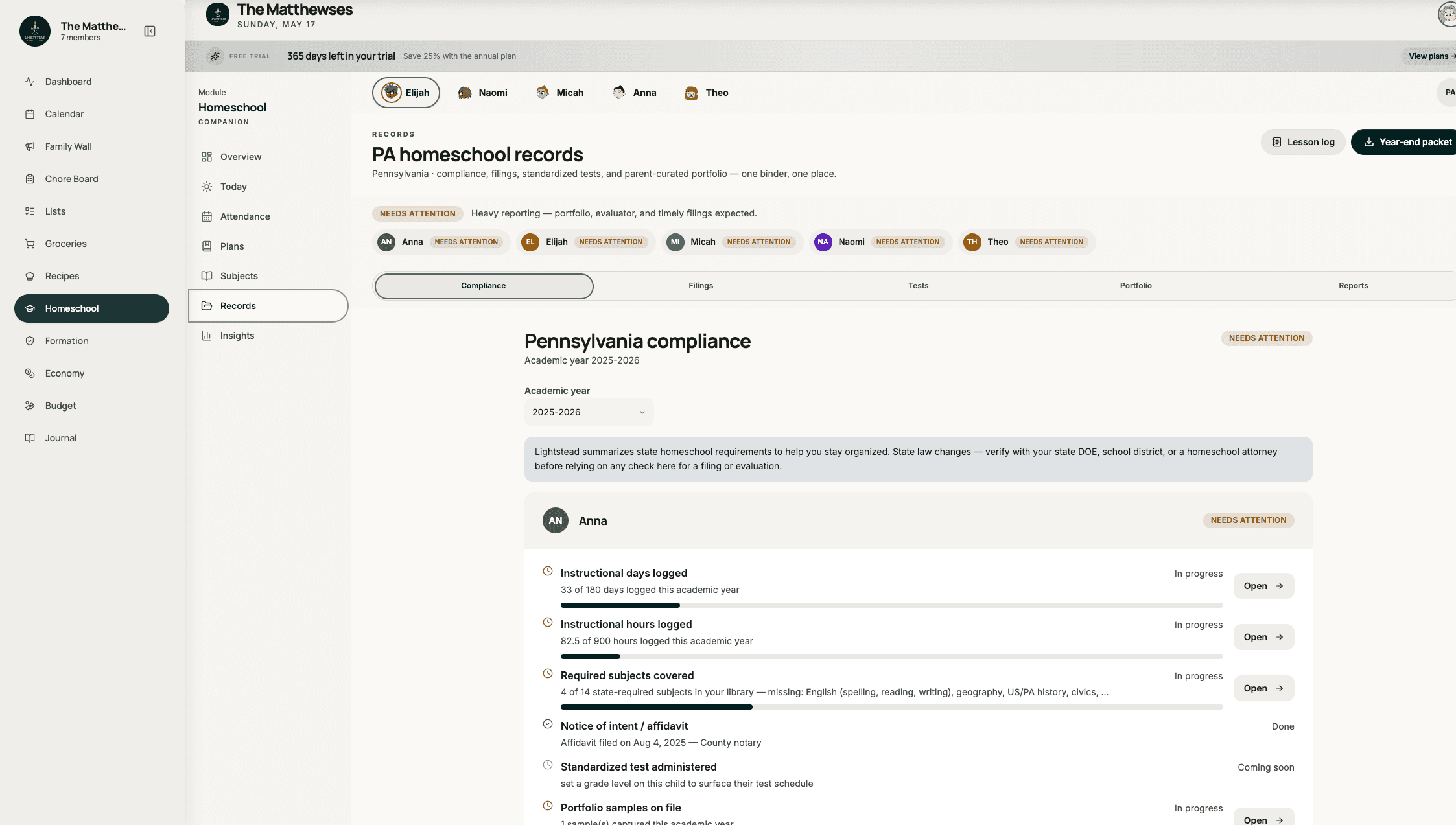
§3
An entirely different pathway — no NOI, no evidence.
Virginia uniquely allows a religious exemption from compulsory attendance under § 22.1-257. Families holding a bona fide religious objection to compulsory school attendance can apply to the local school board for exemption. Once granted, the exemption lasts indefinitely (often until age 18) and removes the NOI, evidence of progress, and superintendent oversight entirely. The religious exemption is a serious application — it requires written statement of belief, often a hearing before the school board, and judicial-style scrutiny. Most VA homeschoolers use the NOI pathway; the religious exemption is for families whose religious convictions specifically object to government-supervised education.
Va. Code § 22.1-257 (religious exemption)
Families with a granted religious exemption use Lightstead for internal records, transcripts, and household coordination — there's no state-facing compliance to track. The exemption removes Virginia's oversight, but transcripts, course descriptions, and the practical record-keeping that helps with college admissions still benefit from the same guidance.
Records & transcripts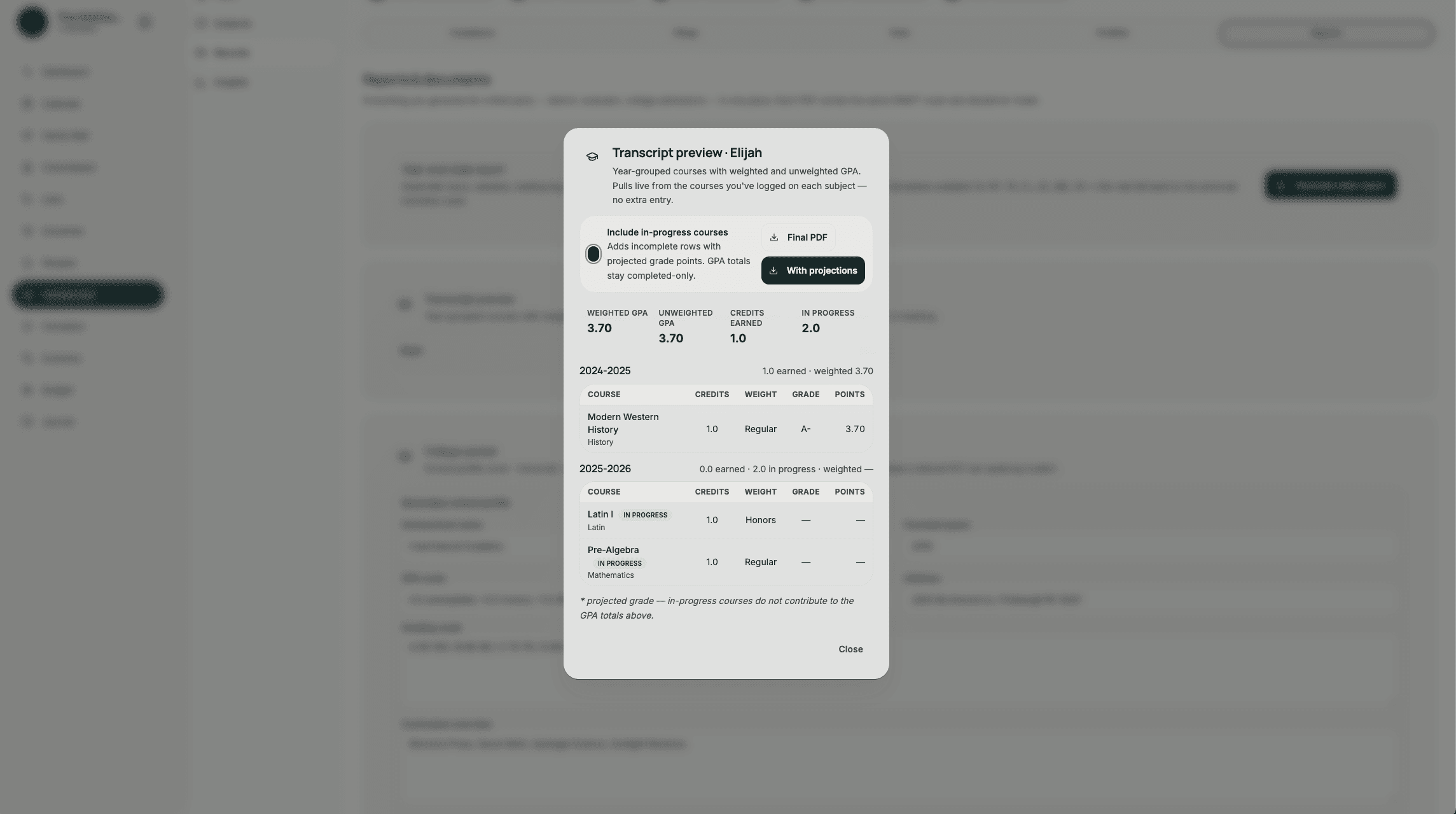
§4
Below 4th stanine — and what happens next.
A composite below the 4th stanine (23rd percentile) on the year's standardized test triggers a 1-year probation under VA law. The family submits a remediation plan to the superintendent and the next year's evidence must show adequate progress. A second consecutive below-stanine year can require enrollment in a public or private school. The stanine threshold is relatively generous (23rd percentile is below average but well within normal range), and most below-stanine outcomes reflect either a poor test fit or a specific subject struggle rather than a systemic homeschool failure. Probation is recoverable.
Va. Code § 22.1-254.1(C)(i)
Lightstead's score-entry screen flags below-stanine composites with a probation banner and links to template remediation plans. The probation year gets its own dashboard view — the cadence is the same as a normal year, but the evidence comes with extra context for the superintendent.
Probation handlingWhat people search for when they look up Virginia homeschooling.
When do I file the Virginia Notice of Intent?
Annually with the division superintendent by August 15. The NOI lists the children, subjects to be taught, and one of four parent qualification options. A family starting mid-year files within a reasonable window of beginning home instruction.
What are the four parent qualification options in Virginia?
(1) High school diploma or higher; (2) current VA teaching license; (3) provision of a curriculum or program of study; or (4) evidence of ability to provide adequate education. Most families use (1) or (3). Option (3) is satisfied by naming a structured curriculum in the NOI.
What evidence of progress does Virginia require?
By August 1 of the year following the academic year, one of four options under § 22.1-254.1(C): (a) nationally-normed standardized test with composite at or above 4th stanine / 23rd percentile (ACT/SAT/PSAT qualify); (b) evaluator letter from a state-licensed teacher or person with a master's degree or higher in an academic discipline; (c) college/community college transcript or distance-learning report; or (d) superintendent-approved alternative.
What's the 4th stanine threshold in Virginia?
The 23rd percentile — a child performing close to grade-level average satisfies. Below the 4th stanine triggers a 1-year probation: the family submits a remediation plan and the next year's evidence must show adequate progress. Two consecutive below-stanine years can require enrollment in a public or private school.
Can I use the SAT or ACT as Virginia evidence of progress?
Yes. The SAT, ACT, and PSAT all qualify as nationally-normed standardized tests under option (a). For high school students taking these for college admissions anyway, the score serves double duty as Virginia evidence of progress — no separate test required.
What's the Virginia religious exemption?
Under § 22.1-257, Virginia families holding a bona fide religious objection to compulsory school attendance can apply for an exemption that lasts indefinitely. The exemption removes the NOI, evidence of progress, and superintendent oversight — but requires a serious application including written statement of belief, often with a school board hearing.
What subjects does Virginia require?
The state does not enumerate required subjects. The family lists subjects to be taught in the annual NOI; the parent picks scope, sequence, and curriculum. The end-of-year evidence of progress demonstrates the year's instruction worked.
Can my Virginia homeschooler join public school sports?
Yes, under Virginia's Tebow Bill (passed 2021). Public school districts must allow homeschool students residing in the district to participate in athletics and extracurriculars on the same terms as enrolled students, with academic eligibility verified by the parent. Specific eligibility procedures vary by district.
Related state guides
Stop tracking Virginia compliance in a spreadsheet.
14-day free trial. No credit card. We'll set up your filings, your hour log, and a portfolio starting point for Virginia.
Start free trial