Homeschooling in Florida— the five-evaluation-option state — pick the path that fits your year.
Florida runs three pathways and five end-of-year evaluation choices: certified teacher, standardized test, state assessment, psychologist, or a mutually agreed alternative. The portfolio is the spine — a contemporaneous log of activities, reading materials, and work samples retained two years. Districts can request inspection with 15 days' notice. Lightstead's FL profile tracks portfolio entries from day one so May's evaluation comes together in a few taps, not a panic.
What Florida requires, at a glance.
- Notice
30 days · one-time
Letter of Intent to county school superintendent within 30 days of beginning. No annual renewal — it sticks until termination.
- Days / hours
Not specified
Statute is silent on instructional days/hours. The annual evaluation is the proof-of-instruction artifact.
- Subjects
Not specified
FL does not enumerate required subjects under the homeschool pathway. Curriculum is parent-defined.
- Assessment
5 options
Certified teacher · norm-ref test · FL state assessment · psychologist eval · mutually agreed alternative.
- Pathway
3 options
Home education statute (§ 1002.41) · umbrella school registration · FL-certified private tutor.
- Portfolio
2-year retention
Contemporaneous log + reading list + work samples. Retained 2 years after each completed year. District can inspect with 15 days' notice.
- Teacher qualification
Not required
No diploma, certification, or qualification statute under the home education pathway. Private tutor pathway requires FL certification.
- Termination
Notice of termination
Letter of Termination to county superintendent when ending homeschooling. Without it, the home education record stays "open."
§1
30 days to file — and then it sticks.
Florida requires a Letter of Intent (LOI) to the county school superintendent within 30 days of beginning homeschooling. The letter includes the child's name, date of birth, and address. There's no annual renewal — once filed, the home education program stays open until a Letter of Termination closes it. Most families never file a second LOI for the same child. The one-time filing is one of the gentlest in the country. Counties have no authority to ask follow-up questions or require additional forms beyond what § 1002.41 specifies. Some districts send a welcome packet; that packet is informational, not regulatory.
Fla. Stat. § 1002.41(1)(a)
Lightstead's FL Letter of Intent wizard pre-fills the child's data and outputs a PDF formatted to the standard county template. After filing, the LOI sits in your records permanently and the dashboard shows your home education program as "open" — until you intentionally close it with a Letter of Termination.
FL Letter of Intent wizard
§2
Contemporaneous log + reading list + work samples.
FL § 1002.41(1)(b) defines the portfolio as three things together: (1) a contemporaneous log of educational activities, (2) a list of titles of reading materials used, and (3) samples of writings, worksheets, workbooks, and creative materials. "Contemporaneous" is the load-bearing word — kept as you go, not reconstructed in April. The portfolio retention is two years after each year completed. The district can request access with 15 days' notice for review. The portfolio is also the source of evidence supporting whichever of the five annual evaluation options you pick — most evaluators want to see the portfolio before signing.
Fla. Stat. § 1002.41(1)(b); § 1002.41(2)
Lessons and reading-log entries flow into the year's record as you log them; work samples are uploaded with a per-sample child + subject tag. The reading-list view assembles all books across all subjects across the year, ready for evaluator export. The 2-year retention rule becomes a Lightstead feature instead of your filing problem.
FL portfolio + reading list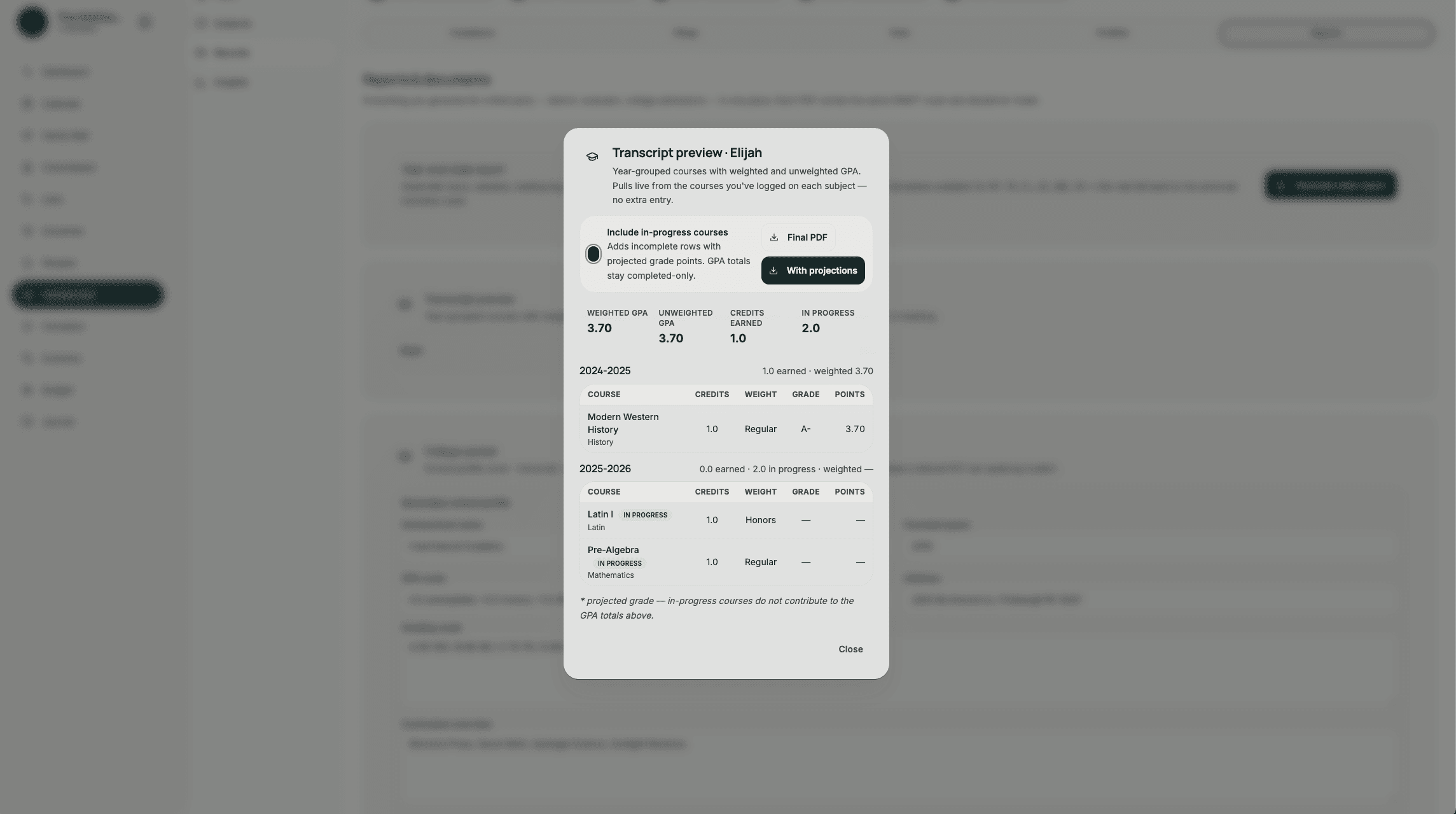
§3
Pick one of five — every May.
FL families pick from five annual evaluation options: (a) FL-certified teacher reviews the portfolio and writes an evaluation letter; (b) child takes a nationally normed standardized test; (c) child takes the FL state assessment; (d) FL-licensed psychologist evaluates; (e) any other valid measurement the parent and superintendent mutually agree on. Most families pick option (a) — a certified teacher reviewing the portfolio runs $30–80 and avoids testing in early grades. The choice can change year to year. The evaluation result goes to the superintendent annually; the portfolio supporting it is retained two years.
Fla. Stat. § 1002.41(2)
The May evaluation comes together in a few taps — the portfolio, reading list, and any test scores collated into a single PDF the certified teacher signs. Lightstead shows a checklist of which option you picked and what artifacts it needs, so nothing's missing the week before submission.
Annual evaluation packet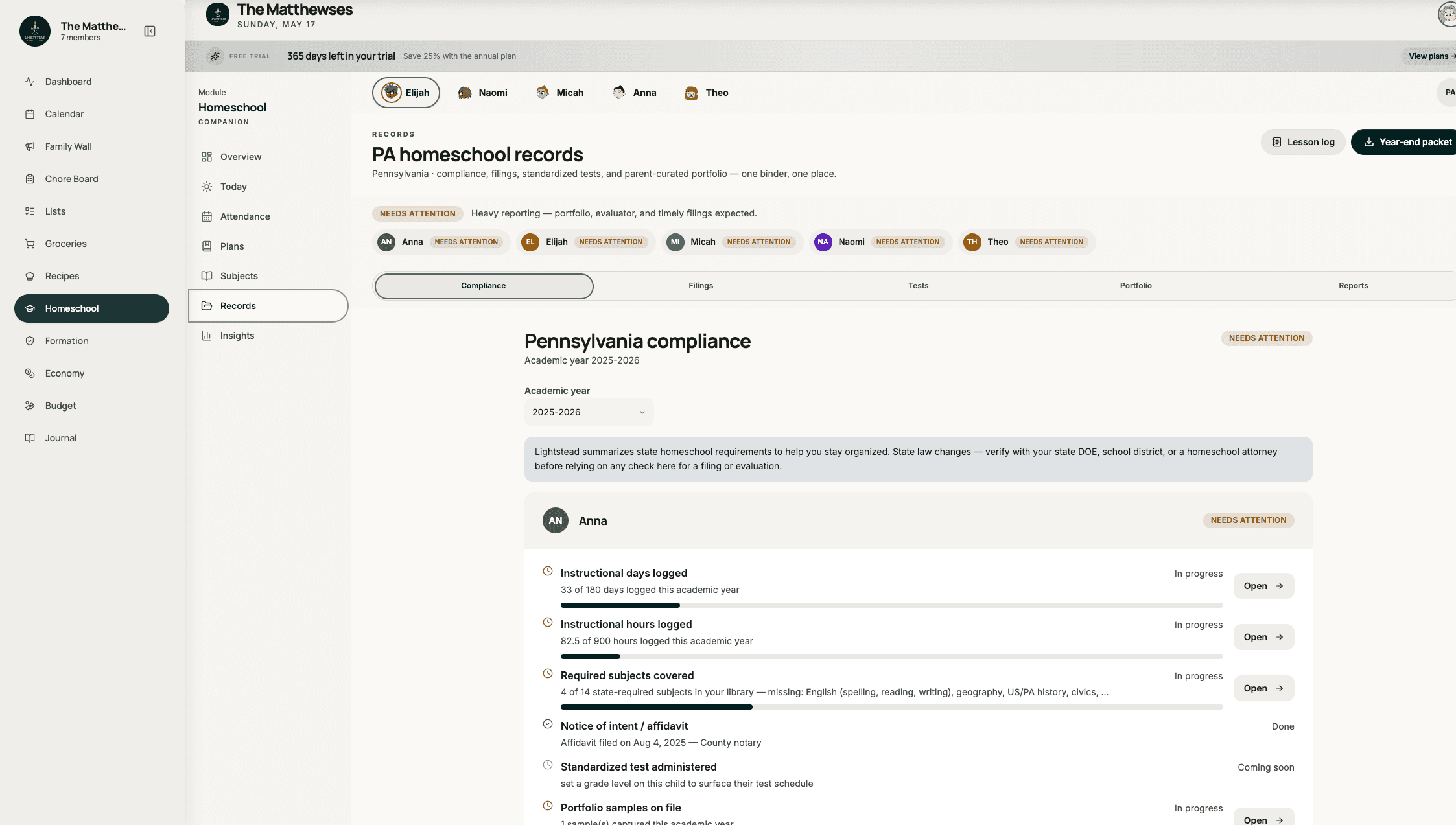
§4
15 days' notice — but it almost never comes.
The county superintendent may request to review the portfolio with 15 days' written notice. In practice this is rare — Florida has roughly 100,000 homeschooled students and inspections are reserved for complaint-driven review, not routine audit. But "rare" is not "never," and the 15-day window is short if you're caught off guard. What the district can see: the contemporaneous log, the reading list, work samples. What they cannot: pry into curriculum choices, religious content, or grading methodology. The review is for evidence-of-instruction, not curriculum approval.
Fla. Stat. § 1002.41(1)(b)
If the 15-day notice ever arrives, Lightstead can produce a date-ordered portfolio PDF in a few clicks — every log entry, every reading-list line, every work sample with timestamps that pre-date the inspection request. "Contemporaneous" is provable by the metadata.
Inspection-ready portfolio exportWhat people search for when they look up Florida homeschooling.
When do I file the Letter of Intent in Florida?
Within 30 days of beginning homeschooling. The letter goes to the county school superintendent and includes the child's name, date of birth, and address. There's no annual renewal — once filed, the home education program stays open until a Letter of Termination closes it.
What does a Florida portfolio need to include?
Three things: a contemporaneous log of educational activities, a list of titles of all reading materials used, and samples of writings, worksheets, workbooks, and creative materials. "Contemporaneous" means kept as you go — reconstructed portfolios are usually obvious and create a legal vulnerability if the district challenges.
How long do I keep my Florida homeschool portfolio?
Two years after each year's completion. The district can request to inspect with 15 days' notice during that window. Lightstead retains indefinitely, so the 2-year retention rule becomes a stored-record feature rather than your filing problem.
Do I have to test my Florida homeschooler?
Not necessarily. FL gives five annual evaluation options: certified teacher review of portfolio, nationally normed standardized test, FL state assessment, FL-licensed psychologist evaluation, or another mutually agreed measure. Most families pick option (a) — certified teacher portfolio review — to avoid testing in early grades.
Who can evaluate my Florida homeschooler?
A Florida-certified teacher in any subject (the most common path), a Florida-licensed psychologist, or another evaluator agreed to by the parent and superintendent. Certified teachers offering homeschool evaluations typically charge $30–80 per child; many advertise to local FPEA chapters.
Does Florida require specific subjects?
No. The home education statute doesn't enumerate required subjects — curriculum is parent-defined. The portfolio must show "a regular program of instruction," which the courts have interpreted as evidence of regular educational activity, not adherence to a state-mandated subject list.
Can my Florida homeschooler join public school sports?
Yes. Florida law (Fla. Stat. § 1006.15) lets homeschool students participate in extracurricular activities at the public school they would otherwise attend. The student must demonstrate the same academic eligibility public-school students must. Specific procedures vary by district.
When do I file the Letter of Termination?
When ending the home education program — child enrolls in public/private school, graduates, or reaches age 16. Without the termination letter, the record stays "open" indefinitely, which doesn't hurt but creates inaccurate state data. Lightstead's termination flow produces it as a single PDF.
Related state guides
Stop tracking Florida compliance in a spreadsheet.
14-day free trial. No credit card. We'll set up your filings, your hour log, and a portfolio starting point for Florida.
Start free trial