
Homeschooling in Texas— the largest no-notice state in the country.
Texas treats homeschools as private schools under the 1994 Leeper decision — no notice, no registration, no portfolio. Four required subjects (reading, spelling/grammar, math, citizenship). The Texas Education Agency has no statutory authority to regulate homeschools. The freedom is real and the responsibility is too — Lightstead gives you the records you'd want if you ever had to prove you taught.
What Texas requires, at a glance.
- Notice
Not required
TX treats homeschools as private schools. No Notice of Intent (NOI), no registration, no annual filing.
- Days / hours
Not specified
Statute is silent on instructional days or hours. Family sets the calendar.
- Subjects
4 required
Reading, spelling and grammar, math, good citizenship (civics). Other subjects encouraged but not mandated.
- Assessment
Not required
No standardized testing required. Parent decides whether to test for college admissions or self-knowledge.
- Pathway
Private school
Leeper v. Arlington ISD (1994) classifies homeschools as private schools under Tex. Educ. Code § 25.086(a)(1).
- Teacher qualification
Not required
No diploma, certification, or qualification statute. Parent has sole authority.
- UIL access
Equal access (Tim Tebow)
Homeschoolers may join public school sports/extracurriculars run by the University Interscholastic League (UIL) via the Tim Tebow law (2021).
- Diplomas
Parent-issued
Parent-issued homeschool diplomas are recognized statewide. No certificate, no notarization, no submission.
§1
Private school by court precedent — no agency oversight.
Texas homeschools are private schools under the 1994 Texas Supreme Court ruling Leeper v. Arlington ISD, which interpreted Tex. Educ. Code § 25.086(a)(1) to include home-based instruction. The Texas Education Agency has no statutory authority to regulate, register, accredit, or inspect homeschools. In practice this means a Texas family can begin homeschooling on any Monday without telling anyone. The only obligations are: teach the four required subjects in a bona fide manner, and meet truancy law if a child was previously enrolled in public school (a withdrawal letter to the district handles that).
Leeper v. Arlington ISD, 893 S.W.2d 432 (Tex. 1994); Tex. Educ. Code § 25.086(a)(1)
Lightstead's Texas profile defaults to no-filing mode — no nag screens, no reminders for things you don't owe. The withdrawal-letter template lives in the filings area for families pulling a child from public school mid-year.
How filings work in Lightstead
§2
Four subjects, bona fide, parent-defined.
Leeper sets a low but real bar: instruction must be "bona fide" (not a sham) and must cover four subjects — reading, spelling and grammar, math, and good citizenship (civics). The court did not specify curricula, grade levels, hours per subject, or assessment. A family teaching those four subjects with any defensible curriculum satisfies the standard. Most Texas families teach far more than the minimum. The requirement is a floor, not a ceiling. The flexibility around scope, sequence, and method is the reason families move to Texas — it's the right tradeoff for some, the wrong fit for others who'd prefer state-defined structure.
Leeper v. Arlington ISD (1994)
The Texas subject list ships with the four required subjects pre-pinned plus optional add-ons (science, history, art, PE, foreign language). Lesson plans tagged to a subject roll into a record-of-instruction PDF you can produce if asked.
Subject planning + lesson records
§3
The Tim Tebow law — equal access to public school sports.
The Tim Tebow law (passed in 2021) requires public school districts to allow homeschool students to participate in UIL athletics and extracurriculars on the same terms as enrolled students. The student must reside in the district's attendance zone, meet eligibility requirements (age, academic progress), and follow team rules. The statute changed Texas from one of the largest states blocking homeschool UIL access to a guaranteed-access state. Many districts now have a designated coordinator for homeschool participation; some require a brief eligibility form attesting to academic progress in the four required subjects. Check current TEA guidance or HSLDA for the latest statutory references and procedural details.
Tim Tebow law (2021); verify current Tex. Educ. Code reference via TEA
When a child enters the UIL eligibility window, Lightstead generates a one-page academic-progress summary suitable for the district coordinator — showing subject coverage and parent attestation. It's not a state-mandated form; it's the artifact most districts ask for.
UIL eligibility packet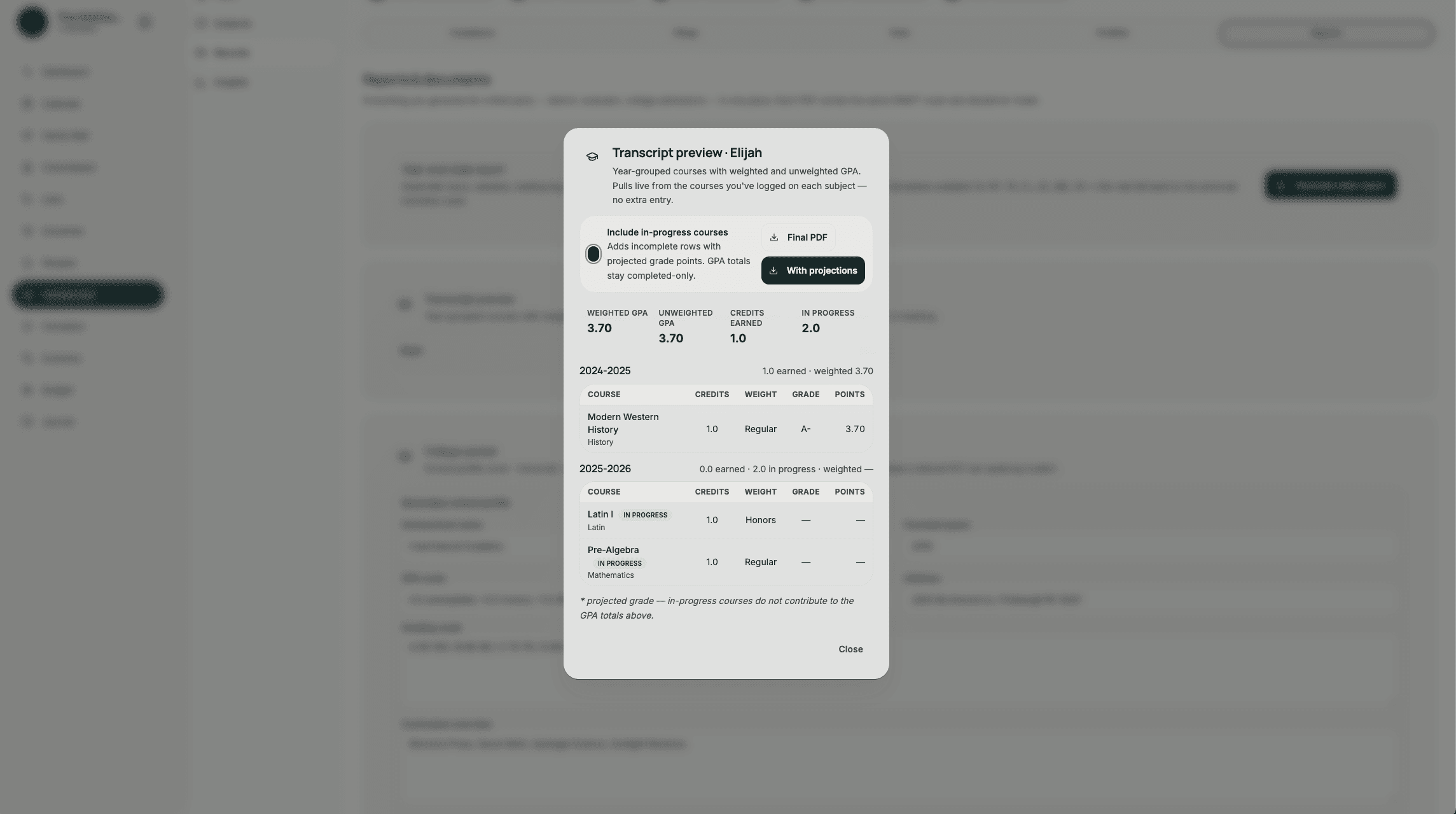
§4
No state record requirement — but you'll want them anyway.
Texas requires no specific records and recognizes parent-issued homeschool diplomas. The TEA has explicitly stated that homeschool diplomas have the same legal weight as public school diplomas for state-recognized purposes (driver's license, employment, in-state college admission via state-supported colleges). The practical reality: while the state requires nothing, colleges and the military will. Many universities ask for a transcript, course descriptions, and reading lists for homeschool applicants. Recordkeeping in TX is for your future self, not the state.
TEA homeschool guidance; Tex. Educ. Code § 25.086(a)(1)
Lightstead builds a transcript as you go — every completed course, every grade, every credit. By the time your high schooler applies to college, the transcript and course-description packet are export-ready. The state didn't ask for it; college admissions will.
Transcripts + course descriptionsWhat people search for when they look up Texas homeschooling.
Do I have to register my homeschool in Texas?
No. Texas is one of about a dozen no-notice states. You don't file an NOI, you don't register with the state or district, and the Texas Education Agency has no authority over homeschools. The only paperwork is a withdrawal letter to the district if a child was previously enrolled in public school.
What subjects must I teach in Texas?
Four: reading, spelling and grammar, math, and good citizenship (civics). The Leeper decision requires "bona fide" instruction in those four — meaning real, not a sham — but the state does not prescribe curricula, hours, grade levels, or sequencing. Most families teach much more than the minimum.
Does Texas require standardized testing?
No. Texas has no testing requirement at any grade. Many families test for their own benchmarking or because their college plans require it (most universities ask for an SAT or ACT in high school), but state law does not compel any assessment.
Are Texas homeschool diplomas recognized?
Yes. The TEA has stated parent-issued homeschool diplomas carry the same legal weight as public school diplomas for state-recognized purposes — driver's license, in-state college admission at public Texas universities, and military enlistment. Out-of-state colleges and private universities set their own policies.
Can my homeschooler play UIL sports?
Yes, under Texas's 2021 Tim Tebow law. Public school districts must allow homeschoolers residing in the district to participate in UIL athletics and extracurriculars on the same terms as enrolled students. Some districts require a brief eligibility form attesting to academic progress. Confirm current statutory references via TEA or HSLDA.
Do I need a high school diploma to homeschool in Texas?
No. Texas does not impose any teacher-qualification requirement on homeschool parents. The state's posture is that the parent has sole authority over a private school under Leeper, and a private school cannot be required to qualify its teachers.
What happens if a school official questions my homeschool?
Texas families have strong precedent (Leeper) and statute (§ 25.086) behind them. A polite letter affirming you're operating a private school under those authorities is usually sufficient. HSLDA membership ($130/yr) provides legal backup if a district pushes harder.
Do I need records if Texas doesn't require them?
Yes — for college, the military, and high-school course-credit purposes. Texas requires no records, but a complete transcript, course descriptions, and reading lists make the difference between an easy and a hard college application. Lightstead builds them as you go so it's not a senior-year scramble.
Related state guides
Stop tracking Texas compliance in a spreadsheet.
Texas asks for almost nothing — but your future self will want transcripts, course descriptions, and a real record of what you taught. Lightstead builds them quietly as you go.
Start free trial