Homeschooling in North Carolina— the DNPE state — one filing, annual testing, simple records.
North Carolina runs its homeschool program through the Division of Non-Public Education (DNPE), one of the simplest, most straightforward state homeschool processes in the country. A one-time Notice of Intent (NOI) once any child reaches age 7, an annual nationally-normed test on file (not submitted), a 9-month regular schedule, and immunization records on hand. No quarterly reports, no portfolio review. Lightstead keeps the test scores and attendance log in one place so the rare DNPE inspection is ready to export in seconds.
What North Carolina requires, at a glance.
- Notice
One-time NOI
NOI to NC Division of Non-Public Education (DNPE) when starting — once any child reaches age 7.
- Days / hours
9 months
Regular 9-month schedule on a calendar similar to public schools. No state-specified hours per day.
- Subjects
Not specified
NC does not enumerate required subjects under the homeschool pathway. Curriculum is parent-defined.
- Assessment
Annual standardized test
Nationally normed achievement test in English grammar, reading, spelling, math. Kept on file (not submitted).
- Pathway
NOI to DNPE
Single pathway — home school registered with NC DNPE under § 115C-563. No umbrella or tutor alternatives at state level.
- Teacher qualification
HS diploma or equiv
Chief administrator and every person who provides academic instruction must hold at least a high school diploma or equivalent (GED).
- Records
Test scores + attendance
Test scores retained 1 year minimum; attendance records on hand; immunization records on file.
- Inspection
DNPE may inspect
DNPE has authority to inspect records on reasonable notice. In practice rare and triggered by complaint, not routine.
§1
One filing — once any child reaches age 7.
North Carolina's homeschool registration happens once, with the NC Division of Non-Public Education (DNPE), when the homeschool first begins operating for a child age 7 or older. NC's compulsory attendance age is 7, so younger children aren't yet "truant" if not enrolled — but the homeschool isn't yet legally registered either. The NOI names the school (you pick a name), the chief administrator (you), and the address — it registers the school itself, not a list of individual children. DNPE returns a registration number. From that point onward, the home school is on DNPE's books. There's no annual renewal — the school stays registered until the family files a closure notice.
N.C.G.S. § 115C-563(a)
Lightstead's NC profile walks you through the DNPE registration the first time and stores the assigned registration number with your account. After that the dashboard shifts to operational mode — testing reminders, attendance tracking, no nag screens for things you don't owe annually.
DNPE registration
§2
One nationally-normed test — every year.
Every NC homeschool student takes a nationally normed standardized achievement test annually. The test must cover English grammar, reading, spelling, and math at minimum. Approved tests include the CAT, Iowa, Stanford, and a small handful of others — any norm-referenced achievement test from a reputable publisher. The results are kept on file by the family. They are not submitted to DNPE. DNPE may inspect records on reasonable notice (rare in practice), and the test scores are the primary inspection artifact. Score retention is at least one year per statute; most families retain longer for high school transcript purposes.
N.C.G.S. § 115C-564
Lightstead tracks the annual test window on your calendar with reminders that get more prominent as the test date nears (60+ days, 30+ days, 14 days and under), stores score certificates in the child's record, and shows a multi-year progression graph so growth (or stagnation) is visible at a glance. The 1-year retention rule becomes indefinite storage by default.
Standardized test records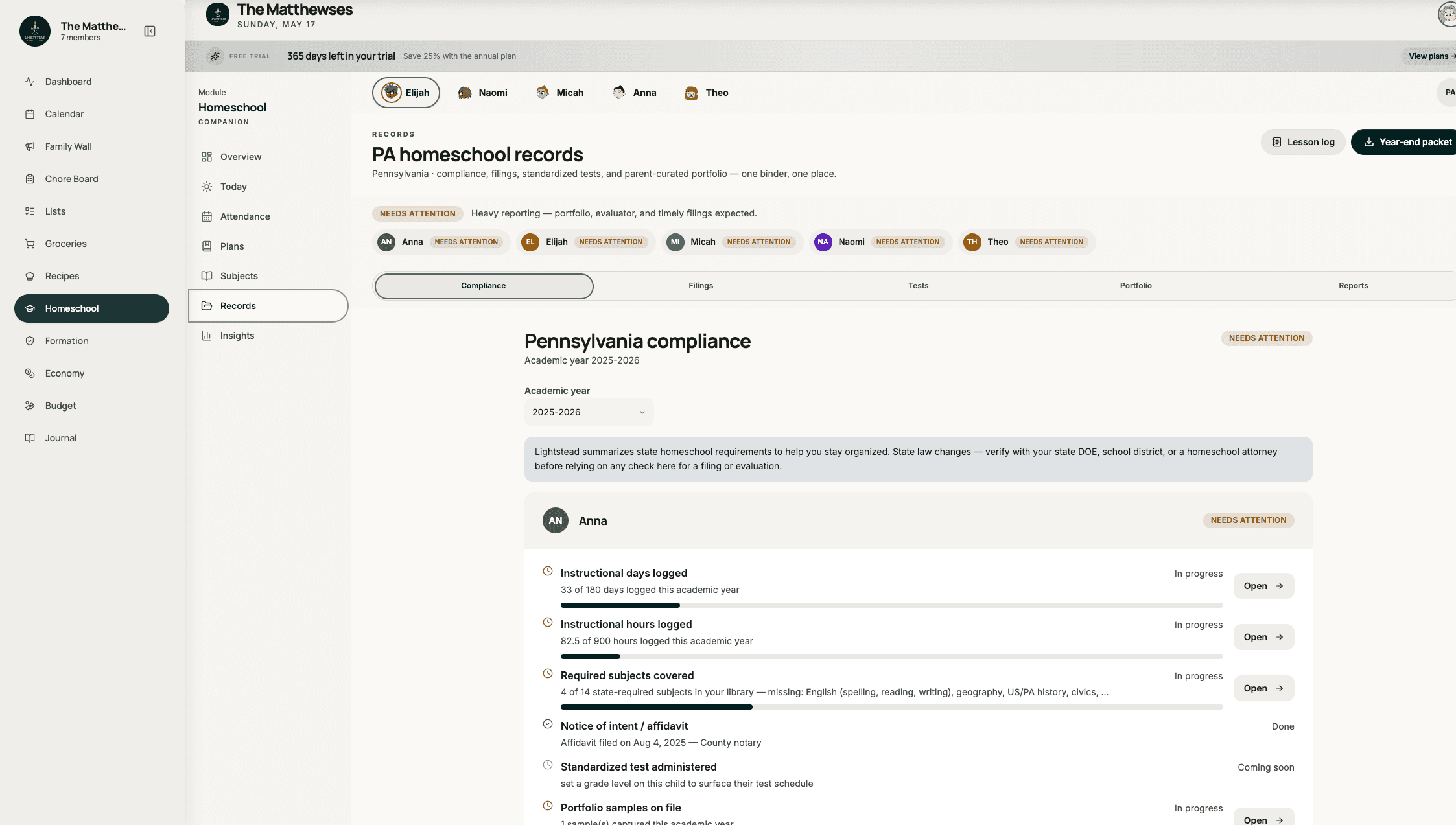
§3
A 9-month calendar — not 9 months of stress.
NC requires the home school to operate on a regular schedule for at least 9 months of the year, on a calendar similar to a public school's. There are no state-specified hours per day or hours per year. "Similar" is read flexibly — a year-round schedule with summer breaks, a traditional Sept–May calendar, or a 4-day week all satisfy the "regular" standard. The attendance record (kept by the family) shows the schedule was real. DNPE doesn't audit calendars routinely; the schedule mostly matters if a complaint is opened. Lightstead's attendance calendar produces a per-year record that proves 9-month operation without needing a separate document.
N.C.G.S. § 115C-564(b)
Drop a green dot for instructional days, blue for field trips, gray for holidays — the calendar shows the 9-month minimum at a glance. Per-child attendance summary exports as a one-page PDF. If DNPE ever asks, you produce it in seconds.
Attendance calendar
§4
A high school diploma — that's it.
NC requires the chief administrator AND every person who provides academic instruction (the homeschooling parent, plus any second parent or tutor who teaches in the household) to hold at least a high school diploma or its equivalent (GED). No teaching credential, no college degree, no subject-area certification. Foreign credentials of equivalent secondary-level completion are accepted; DNPE has approved many on submission. This is one of the lighter teacher-qualification standards in the country. Each instructor's qualification is documented with the original NOI filing and not re-verified annually unless the chief administrator or instructor roster changes.
N.C.G.S. § 115C-564
The chief administrator's qualification lives in the family profile and shows up on the NOI export. If a second parent takes over instruction, Lightstead reminds you to file the administrator change with DNPE — it's a one-page form, but easy to forget.
Administrator profileWhat people search for when they look up North Carolina homeschooling.
When do I register my homeschool in North Carolina?
When the homeschool begins operating for a child age 7 or older. NC's compulsory attendance age is 7; younger children don't trigger a registration requirement. The NOI to NC DNPE establishes the school once — there's no annual renewal until the family files a closure notice.
What test does North Carolina require?
A nationally normed standardized achievement test covering English grammar, reading, spelling, and math at minimum. Approved tests include the CAT, Iowa, Stanford, and similar. The parent picks the test; results are kept on file but not submitted to DNPE unless requested.
Does North Carolina require specific subjects?
No. NC does not enumerate required subjects under the homeschool pathway — curriculum is parent-defined. The annual standardized test implicitly covers reading, grammar, spelling, and math, but the curriculum that prepares for the test is the family's choice.
How long do I keep North Carolina homeschool records?
Test scores at least one year by statute. Attendance records on hand for the current and prior school years. Immunization records on file indefinitely. In practice, NC homeschoolers retain test scores far longer for high school transcript purposes — Lightstead keeps them indefinitely.
Does DNPE inspect homeschools?
DNPE has authority to inspect records on reasonable notice, but routine audit is rare. Most inspections are complaint-driven. The inspection covers the standardized test scores, attendance records, and immunization records. Curriculum and teaching methods are not subject to inspection.
Do I need a high school diploma to homeschool in NC?
Yes. The chief administrator and every person who provides academic instruction (a second parent or tutor who teaches counts) must hold at least a high school diploma or equivalent (GED). No teaching credential or college degree required. Foreign equivalent secondary credentials are accepted on submission.
How many days of school does North Carolina require?
A regular 9-month schedule on a calendar similar to public schools. NC does not specify hours per day. A year-round schedule, traditional Sept–May calendar, or 4-day week all satisfy as long as the schedule is regular and the calendar is similar in structure.
Can my NC homeschooler play public school sports?
It varies by district. Unlike some states with statewide equal-access laws, North Carolina has no statewide statute guaranteeing homeschool participation in public-school sports, and the NCHSAA has not adopted an equal-access policy. Some districts allow participation through dual enrollment or specific local agreements; others don't. Check with your local school district directly.
Related state guides
Stop tracking North Carolina compliance in a spreadsheet.
14-day free trial. No credit card. We'll set up your filings, your hour log, and a portfolio starting point for North Carolina.
Start free trial