
Homeschooling in Vermont— annual enrollment notice, 175 days, and a year-end assessment you keep.
Vermont calls homeschooling "home study" and asks for an annual enrollment notice to the Agency of Education, which must acknowledge a complete notice within 10 business days. As of July 1, 2023 the notice was simplified — a minimum course of study, prior-year progress evidence, and instructor identification are no longer required in the notice itself. You provide the equivalent of 175 days of instruction and complete an end-of-year assessment each year, choosing from five accepted methods. The assessment is kept by you, not sent to the state — and that record is the one your future self will want. Lightstead files the notice, logs the 175 days, and stages the year-end assessment so it is ready whether or not anyone ever asks.
What Vermont requires, at a glance.
- Notice
Annual enrollment
Annual home study enrollment notice to the Agency of Education; the Agency must acknowledge a complete notice within 10 business days.
- Notice contents
Simplified (2023)
As of July 1, 2023, the notice no longer requires a minimum course of study, prior-year progress evidence, or instructor identification.
- Days / year
175 days
Provide the equivalent of 175 days of instruction per year. The statute counts days, not hours.
- Subjects
Required by statute
16 V.S.A. § 166b requires basic communication skills (reading, writing, numeracy), citizenship/history/government (Vermont & US), physical education & health, literature, the natural sciences, and the fine arts. As of July 1, 2023 you no longer list them in the notice, but the instruction is still required; the parent picks materials, scope, and sequence.
- Year-end assessment
Required · 5 methods
An end-of-year assessment is required each year — standardized test, certified-teacher report, portfolio, online-school grades, or GED evidence.
- Assessment filing
Kept, not submitted
The assessment is kept by the parent — it is NOT submitted to the Agency of Education. Keep it on hand.
- Teacher qualification
None required
No teacher qualification, notarization, or background-check requirement to run a Vermont home study program.
§1
File the annual enrollment notice — and wait for the acknowledgment.
Vermont's home study law requires an annual enrollment notice to the Agency of Education for each home study program. The Agency must acknowledge a complete notice within 10 business days; the acknowledgment confirms the program is enrolled for the year. As of July 1, 2023 the notice was simplified. A minimum course of study, evidence of the prior year's progress, and identification of the instructor are no longer required in the notice itself — the filing is lighter than it once was, but it is still an annual obligation rather than a one-time registration.
16 V.S.A. § 166b; 16 V.S.A. § 11(a)(21)
The Vermont filing wizard assembles the annual enrollment notice, pre-fills your children's data, and outputs a notice ready for the Agency of Education. The annual deadline and the 10-business-day acknowledgment window show on your dashboard so the year doesn't lapse unnoticed.
Vermont filing wizard
§2
The equivalent of 175 days a year.
Vermont expects the equivalent of 175 days of instruction across the home study year. The measure is days, not hours — there is no minute or hour count to total, and no prescribed daily schedule. The 175-day equivalent is the practical proof that the year happened. Because Vermont frames it as days of instruction, a simple attendance record showing the days school was in session is the cleanest evidence — useful if you ever move, return to a school, or apply to college and are asked what the year looked like.
16 V.S.A. § 166b
Lightstead's attendance log tracks days of instruction toward the 175-day equivalent, with a running count so you can see where the year stands at a glance. The log exports cleanly if you ever need to show a district or college what the year covered.
Attendance & days log
§3
Five ways to close the year — and you keep the result.
Vermont requires an end-of-year assessment for each home study student. Five methods are accepted: (1) a standardized assessment; (2) a report from a Vermont-certified teacher; (3) a portfolio with a written summary plus four or more work samples; (4) grades from an online academy or school; or (5) evidence of passing the GED. The distinctive part: the assessment is kept by the parent, not submitted to the Agency of Education. Vermont asks that the assessment exist, not that it be filed. Keeping it organized matters precisely because no one collects it for you — it is the record a future move, a return to school, or a college application will draw on.
16 V.S.A. § 166b
Lightstead stages whichever assessment method you choose — a portfolio with its summary and four-plus work samples, a certified-teacher report, standardized scores, online-school grades, or GED evidence — into one packet you keep on hand. Because Vermont doesn't collect it, the goal is a record that holds up later, not a form to send in.
Year-end assessment packet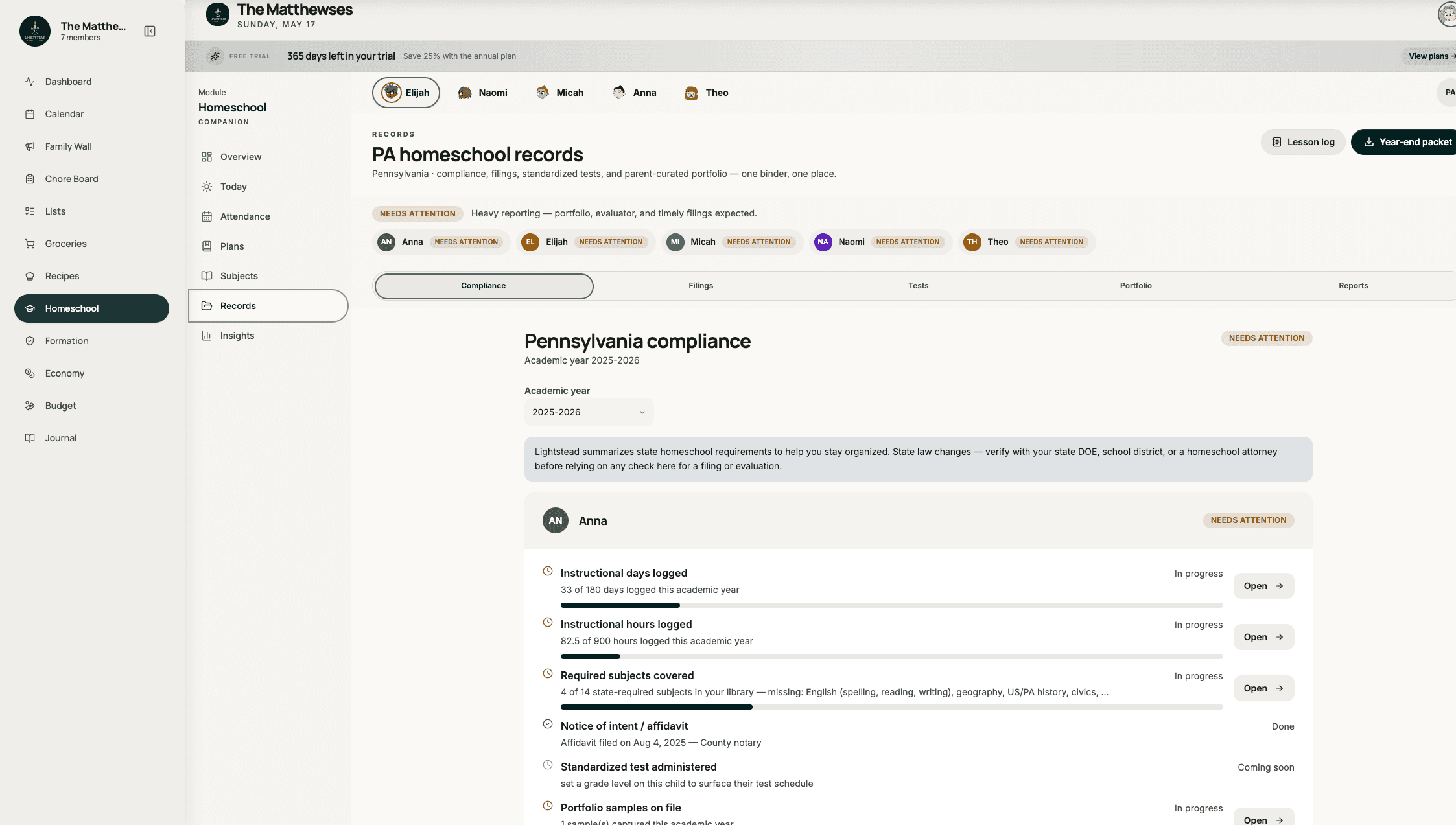
§4
No teacher qualification, notarization, or background check.
Vermont imposes no teacher qualification requirement on the home study instructor — there is no diploma, license, or degree threshold to teach your own children. The enrollment notice does not need to be notarized, and there is no background-check requirement to run a home study program. The 2023 simplification removed the minimum course of study, prior-year progress evidence, and instructor identification from the notice itself — but the underlying subjects of instruction in 16 V.S.A. § 166b (basic communication skills, citizenship/history/government, physical education and health, literature, the natural sciences, and the fine arts) are still required; you simply no longer enumerate them in the filing. Vermont's home study obligations now reduce to four durable pieces: file the annual notice, teach those required subjects, provide 175 days of instruction, and complete the year-end assessment you keep. Knowing exactly what is and isn't required keeps the focus on the record-keeping that actually serves you.
16 V.S.A. § 166b
Lightstead's subjects list and daily lesson log capture what you actually taught — not because Vermont's notice requires a course of study anymore, but because a clear subject record and lesson trail are what a transcript, a district transfer, or a college application are built from.
Subjects & lesson log
What people search for when they look up Vermont homeschooling.
Do I have to register my homeschool in Vermont?
Yes. Vermont calls it "home study" and requires an annual enrollment notice to the Agency of Education for each home study program. The Agency must acknowledge a complete notice within 10 business days. It is an annual filing, not a one-time registration.
What changed in Vermont's homeschool law in 2023?
As of July 1, 2023, the enrollment notice was simplified. A minimum course of study, evidence of the prior year's progress, and identification of the instructor are no longer required in the notice itself. The annual notice, the 175 days of instruction, and the year-end assessment all remain.
How many days does Vermont require for homeschool?
The equivalent of 175 days of instruction per year. Vermont counts days, not hours — there is no minimum minute or hour total and no prescribed daily schedule. A simple attendance record of the days school was in session is the cleanest evidence.
Does Vermont require homeschool testing?
Vermont requires an end-of-year assessment, but a standardized test is only one of five accepted methods. You can instead use a report from a Vermont-certified teacher, a portfolio with a written summary plus four or more work samples, grades from an online academy or school, or evidence of passing the GED.
Do I have to submit the year-end assessment to the state in Vermont?
No. The end-of-year assessment is kept by the parent — it is not submitted to the Agency of Education. Vermont asks that the assessment exist, not that it be filed, which is exactly why keeping it organized matters: no one collects it for you.
How long does Vermont take to acknowledge a homeschool notice?
The Agency of Education must acknowledge a complete enrollment notice within 10 business days. The acknowledgment confirms your home study program is enrolled for the year. If your notice is incomplete, the clock runs once it is complete.
What are the assessment options for Vermont home study?
Five: (1) a standardized assessment; (2) a report from a Vermont-certified teacher; (3) a portfolio with a written summary plus four or more work samples; (4) grades from an online academy or school; or (5) evidence of passing the GED. You pick the method that fits the student each year.
Do I need a teaching license to homeschool in Vermont?
No. Vermont imposes no teacher qualification requirement on the home study instructor — no diploma, license, or degree threshold to teach your own children. There is also no notarization requirement on the notice and no background-check requirement to run the program.
What subjects does Vermont require for homeschool?
16 V.S.A. § 166b requires instruction in basic communication skills (reading, writing, numeracy), citizenship/history/government (Vermont and US), physical education and comprehensive health, literature, the natural sciences, and the fine arts. Since the July 1, 2023 simplification you no longer list those subjects in the enrollment notice, but you must still teach them — the parent chooses the materials, scope, and sequence. The other durable obligations are the annual notice, 175 days of instruction, and the year-end assessment.
Does a portfolio satisfy Vermont's assessment requirement?
Yes. A portfolio is one of the five accepted end-of-year assessment methods. To qualify it needs a written summary plus four or more work samples. Because Vermont does not collect the assessment, the portfolio lives in your own records on hand.
Related state guides
Stop tracking Vermont compliance in a spreadsheet.
14-day free trial. No credit card. We'll set up your filings, your hour log, and a portfolio starting point for Vermont.
Start free trial