
Homeschooling in Rhode Island— the local-committee state — your town approves, not the state.
Rhode Island is the unusual high-oversight state where compliance runs through your local school committee, not a state agency. You file an annual notice of intent with the committee in the town where the child resides, teach the same number of days as the public schools (180), and keep an attendance register you make available to the committee at year-end. The statute itself does not require standardized testing or an outside evaluator, but each committee may adopt its own additional policies — so what your neighbor's district asks for and what yours asks for can genuinely differ. Lightstead tracks the annual notice, logs your days and attendance, and keeps the records your committee can ask to see in one place.
What Rhode Island requires, at a glance.
- Notice
Annual · local committee
Annual notice of intent to the local school committee in the town where the child resides. No single statewide form — the committee approves.
- Approval body
Local school committee
Approval runs through the school committee where the child lives, not the state DOE. Districts vary in what they ask for.
- Instructional days
180 days
Teach the same number of days the public schools are in session — 180 days. The day count, not an hour total, is the measure.
- Subjects
9 required
R.I. Gen. Laws § 16-19-2 requires instruction in reading, writing, geography, arithmetic, health, physical education, U.S. history, Rhode Island history, and the principles of American government; the parent picks materials, scope, and sequence.
- Attendance record
Register required
Maintain an attendance register and make it available to the school committee at year-end.
- Testing
Not required by statute
State law does not require standardized testing — but your local committee may adopt its own testing policy. Verify with your district.
- Evaluator
Not required by statute
No external evaluator is required at the state level. A committee may add its own review; confirm locally.
- Teacher qualification
None at state level
No parent teaching credential, notarization, or background check is required by the state. A committee may have its own expectations.
- District variance
Significant
Because the committee approves, the practical requirements differ town to town. Always confirm your own committee's current policy.
§1
File with your local school committee — every year.
Rhode Island routes homeschool compliance through the local school committee in the town where the child resides, under R.I. Gen. Laws § 16-19-2. Each year you submit a notice of intent to that committee, which approves home instruction for children who would otherwise be required to attend public school. There is no single statewide form and no state-agency filing — the committee is the approving body. Because approval is local, the exact paperwork and process vary by district. Some committees use a short intent letter; others have an application packet and a defined approval cycle. The constant across the state is that the notice is annual and goes to the committee where you live — so the first practical step is to find your own committee's current policy and deadline.
R.I. Gen. Laws § 16-19-2
Lightstead's filing wizard stages your annual notice of intent and stores the committee's response alongside it, so each year's approval is on file when you need it. The deadline shows as a dashboard card once your filing window opens.
Annual notice wizard
§2
Match the public schools — 180 days.
Rhode Island home instruction must run for substantially the same number of days that the public schools are in session, under R.I. Gen. Laws § 16-19-2 — 180 days. The measure is a day count, not an hour total: the requirement is that your school year is as long as the district's. The same statute names the subjects the program must cover — reading, writing, geography, arithmetic, health, physical education, U.S. history, Rhode Island history, and the principles of American government — though there is no daily time minimum and you choose the materials, scope, and sequence within them. What the committee can verify is that instruction took place across the required number of days, which is why a running day count and an attendance record are the artifacts that matter most here.
R.I. Gen. Laws § 16-19-2
Lightstead's attendance log counts your instructional days toward the 180-day mark and shows progress at a glance, so you know in March whether you're on pace rather than discovering a shortfall in June.
Days & attendance log
§3
Keep the register the committee can ask to see.
Under R.I. Gen. Laws § 16-19-2, you must maintain an attendance register and make it available to the school committee at the end of the year. This is the document that demonstrates the required days of instruction were met, and it is the record most committees expect to review as part of year-end accountability. The register is straightforward — dates of instruction across the school year — but it has to actually exist and be retrievable when the committee asks. Reconstructing attendance after the fact is exactly the situation the year-end review is designed to catch, so the register is best kept as you go rather than assembled in June.
R.I. Gen. Laws § 16-19-2
Lightstead keeps your attendance register current as you log each day and exports it as a clean PDF for the committee's year-end review — no rebuilding the year from memory. The daily lesson log feeds the same record, so attended days and what was covered stay linked.
Attendance register§4
What your committee asks for may not be what your neighbor's asks for.
The statute does not require standardized testing or an external evaluator at the state level, and there is no state teacher-qualification, notarization, or background-check requirement under R.I. Gen. Laws § 16-19-2. But because each local school committee approves home instruction, a committee may adopt its own additional policies — testing, a portfolio review, a meeting, or a particular application format. This is the defining feature of homeschooling in Rhode Island: the floor is set by the statute, but your actual obligations are set by your town. Two families in adjacent districts can face meaningfully different requirements. Before you file, confirm your own committee's current policy directly — the state-level summary is the starting point, not the full picture.
R.I. Gen. Laws § 16-19-2 (local committee policy varies)
When your committee asks for more than the statutory minimum, Lightstead is ready: the records packet pulls your subjects list, daily lesson log, and attendance into one portfolio, and the transcript builder is on hand if your district wants graded records too. You hold a complete file regardless of what your town requires.
Records & portfolio packet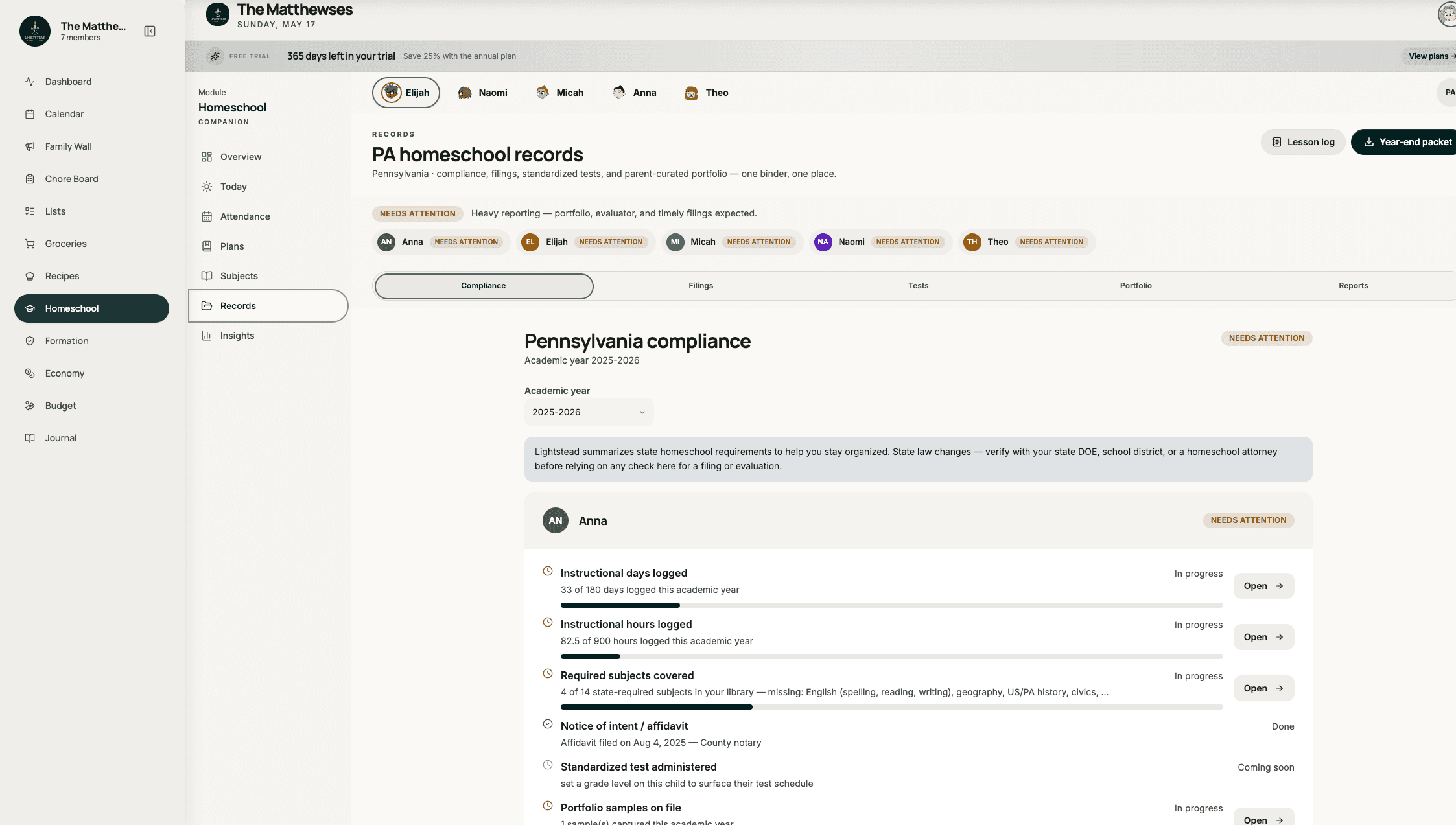
What people search for when they look up Rhode Island homeschooling.
Do I have to register my homeschool in Rhode Island?
Yes. Rhode Island requires an annual notice of intent to the local school committee in the town where the child resides, under R.I. Gen. Laws § 16-19-2. The committee — not a state agency — approves home instruction. There is no single statewide form, so you file with your own town's committee.
Who approves homeschooling in Rhode Island?
Your local school committee. Rhode Island is unusual in that compliance runs through the committee in the town where the child lives rather than the state Department of Education. This is why requirements can vary noticeably from one district to the next.
How many days does Rhode Island require?
180 days. Home instruction must run for substantially the same number of days that the public schools are in session. The measure is a day count rather than an hour total, which is why the attendance register is the key proof artifact.
Does Rhode Island require homeschool testing?
Not at the state level — R.I. Gen. Laws § 16-19-2 does not require standardized testing or an external evaluator. However, your local school committee may adopt its own testing or review policy as a condition of approval, so confirm what your specific district requires before you file.
What records do I have to keep to homeschool in Rhode Island?
You must maintain an attendance register and make it available to the school committee at the end of the year. The register documents that the required days of instruction were met. Keeping a daily lesson log and a portfolio of work alongside it is wise, especially if your committee adds its own review.
Are homeschool requirements the same across Rhode Island?
No. Because each local school committee approves home instruction, the practical requirements can differ significantly town to town. The statute sets the floor — annual notice, 180 days, an attendance register — but your committee may add policies on top. Always verify your own district's current rules.
Does Rhode Island require a teaching license or background check to homeschool?
No teacher qualification, notarization, or background check is required at the state level under R.I. Gen. Laws § 16-19-2. A local committee could have its own expectations as part of approval, so it is worth confirming your district's policy, but there is no statewide credential requirement for parents.
What subjects does Rhode Island require homeschoolers to teach?
R.I. Gen. Laws § 16-19-2 requires instruction in reading, writing, geography, arithmetic, health, physical education, U.S. history, Rhode Island history, and the principles of American government. There is no daily time minimum, and you choose the materials, scope, and sequence — alongside the annual notice, the 180-day instructional year, and the attendance register. Your local committee may add to this as part of its approval, so check your district's process.
When do I file my Rhode Island notice of intent?
The notice is annual and goes to your local school committee, but the exact deadline and format are set by that committee, not by a single statewide rule. Find your own committee's current filing window and application process — that is the first practical step each school year.
Is Rhode Island a hard state to homeschool in?
Rhode Island is a high-oversight state, mainly because approval runs through your local school committee and districts vary in what they require. The statutory baseline — annual notice, 180 days, an attendance register — is manageable, but the real work is confirming and meeting your specific town's policies each year.
Related state guides
Stop tracking Rhode Island compliance in a spreadsheet.
14-day free trial. No credit card. We'll set up your filings, your hour log, and a portfolio starting point for Rhode Island.
Start free trial