Homeschooling in Maryland— the portfolio state — file 15 days out, then keep a real record.
Maryland gives parents four pathways and no test to pass. The main path is the Portfolio Option: file notice with your local superintendent 15 days before you start, renew it each year, and keep a portfolio that the superintendent may review up to three times annually. There is no minimum number of days or hours, no standardized testing, and no state-level teacher qualification — the portfolio is the only proof artifact, and you get 30 days to cure if anything is missing. The other three pathways place you under a church, church-exempt school, or state-approved school umbrella that supervises instead. Lightstead's Maryland profile tracks the renewal cadence and assembles the portfolio packet as you teach.
What Maryland requires, at a glance.
- Notice
15 days · then annual
Initial notice to your local superintendent 15 days before starting, plus an annual renewal to stay current.
- Pathways
4 options
Portfolio Option (independent) · church umbrella · church-exempt school umbrella · state-approved school umbrella.
- Reviews
Up to 3× / year
Under the Portfolio Option the superintendent may review your portfolio up to three times a year at a mutually agreeable time and place; 30 days to cure any deficiency.
- Days / hours
Not required
Maryland sets no minimum instructional days or hours. The portfolio, not a clock, is what demonstrates regular, thorough instruction.
- Assessment
No testing required
No standardized testing is required at any grade. Progress is shown through the portfolio of work, not a test score.
- Teacher qualification
None at state level
Maryland specifies no parent teacher-qualification requirement. Any parent may provide instruction under the Portfolio Option.
- Portfolio
Materials + samples
Instructional and reading materials, writing samples, worksheets, workbooks, creative materials, and tests — kept to show regular instruction.
- Subjects
8 required
COMAR 13A.10.01.05 requires regular, thorough instruction in math, English, social studies, science, art, music, health, and physical education; the family chooses curriculum and scope, and the portfolio evidences instruction across them.
§1
File 15 days before you start — then renew every year.
Maryland requires notice to your local superintendent 15 days before home instruction begins. The notice signs you up to provide regular, thorough instruction in the studies usually taught in the local public schools to children of the same age. The notice is not a one-and-done filing: an annual renewal keeps your home-instruction program current with the local school system each year. The 15-day lead time matters most when you withdraw mid-year — file before you stop sending the child to school, not after. Once you are established, the work each year is the annual renewal plus keeping the portfolio that the superintendent may ask to see.
COMAR § 13A.10.01.05
The Maryland filing helper drafts your initial notice and the annual renewal, pre-fills your children's data, and outputs a PDF for the superintendent. The renewal date shows on your dashboard ahead of time so the yearly filing never slips.
Maryland filing helper
§2
The independent path — reviews up to three times a year.
Under the Portfolio Option you homeschool independently, supervised directly by your local superintendent rather than an umbrella organization. The superintendent may review your portfolio up to three times during the school year, at a time and place mutually agreeable to you and the reviewer. The review confirms that regular, thorough instruction is taking place across the subjects you teach. If a review finds the program is not providing regular, thorough instruction, you are given 30 days to cure the deficiency and bring the portfolio into compliance. There is no minimum number of days or hours and no standardized test — the portfolio is the proof, so the moat is keeping it organized and current rather than reconstructing it the night before a review.
COMAR § 13A.10.01.05
Lightstead's records packet assembles the Maryland portfolio as you go — pulling daily lesson logs, work samples, and subjects into one review-ready PDF. When a review is scheduled you bring the packet, not a shoebox, and the 30-day cure window has a place on the dashboard if you ever need it.
Portfolio records packet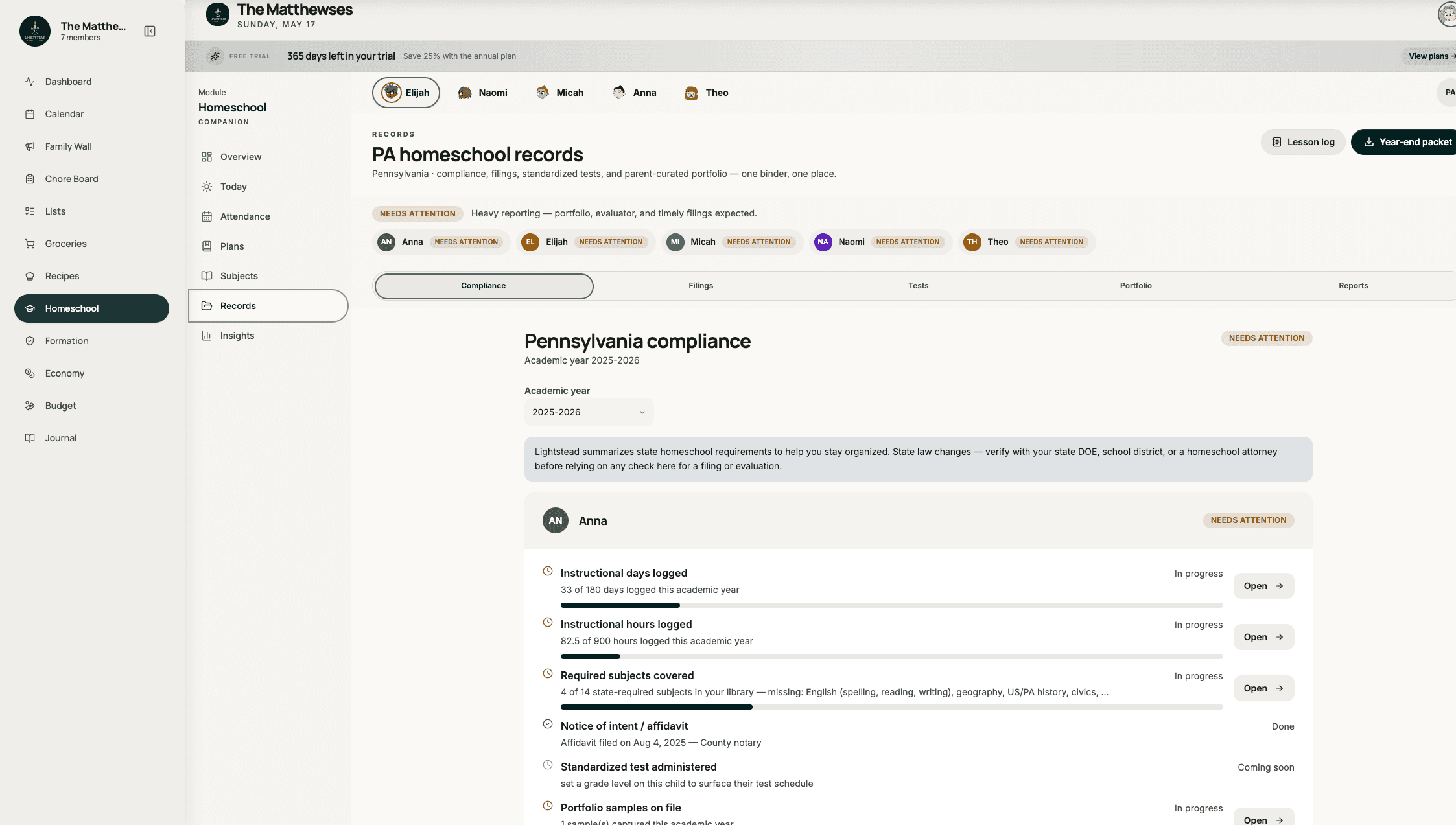
§3
Three umbrellas that supervise in the superintendent's place.
Instead of the Portfolio Option, a family may enroll under one of three umbrellas: (1) a bona fide church organization that provides supervision, (2) a church-exempt school, or (3) a state-approved school that assigns a supervising teacher. Under any umbrella the supervising body — not the superintendent — oversees your instruction, so you are not subject to the superintendent's portfolio reviews. Umbrella supervision is not lighter, just different. The umbrella requires a pre-enrollment conference, a review of your textbooks and lesson plans, periodic conferences during the year, and an annual verification that instruction is taking place. Families often choose an umbrella to work with a like-minded organization or to avoid direct district review.
COMAR § 13A.10.01.05
Whichever umbrella you join, Lightstead keeps the records the supervisor asks for — textbook and lesson-plan lists for the pre-enrollment conference, a running subjects list, and the periodic-conference notes — in one place. The annual verification is easier when the year's instruction is already logged.
Subjects & lesson plans
§4
What a Maryland portfolio actually contains.
The portfolio is a collection of materials that demonstrate the instruction you are providing. Maryland's portfolio includes instructional materials, reading materials, writing samples, worksheets, workbooks, creative materials, and tests. It does not have to be elaborate — it has to show, across the subjects you teach, that regular and thorough instruction took place. Because there is no testing requirement and no hour minimum, the portfolio carries the entire compliance burden under the Portfolio Option. Building it continuously — a writing sample here, a worksheet there, a record of what was covered each day — turns the up-to-three reviews a year into a formality instead of a scramble.
COMAR § 13A.10.01.05
The daily lesson log captures what each child covered, and Lightstead files writing samples, worksheets, and tests against the right subject automatically. When a review approaches, the portfolio is already assembled — you export it rather than build it.
Daily lesson log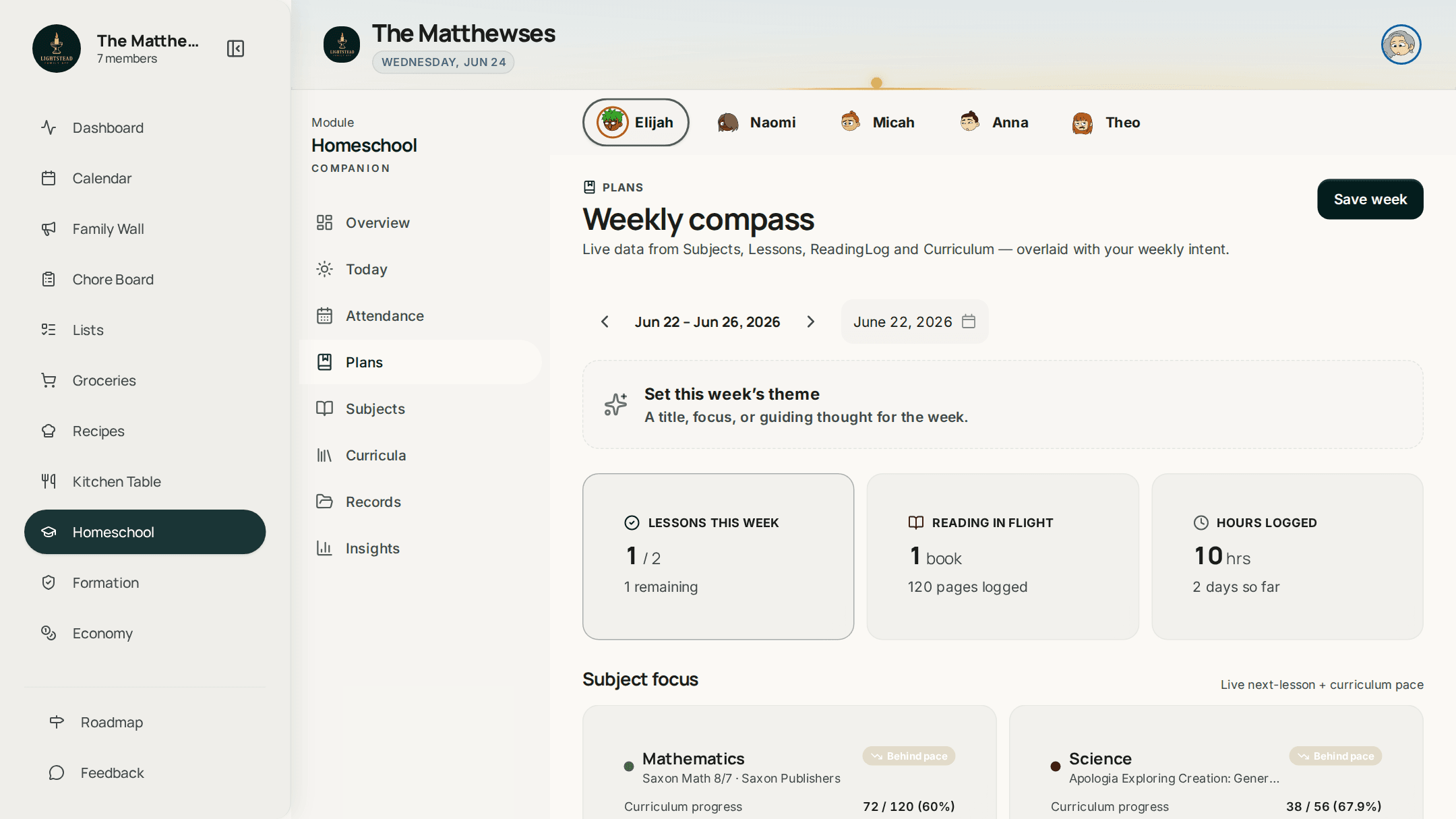
What people search for when they look up Maryland homeschooling.
How do I start homeschooling in Maryland?
Choose a pathway and file notice with your local superintendent 15 days before you begin. Most families use the Portfolio Option — you sign up to provide regular, thorough instruction, renew the notice each year, and keep a portfolio the superintendent may review. The alternative is enrolling under a church, church-exempt school, or state-approved school umbrella that supervises in the district's place.
Does Maryland require standardized testing?
No. Maryland requires no standardized testing at any grade. Progress is demonstrated through your portfolio of work rather than a test score — under the Portfolio Option the superintendent reviews the portfolio, not test results.
How often does Maryland review my portfolio?
Under the Portfolio Option, the superintendent may review your portfolio up to three times during the school year, at a time and place mutually agreeable to you and the reviewer. If a review finds instruction isn't regular and thorough, you have 30 days to cure the deficiency.
What goes in a Maryland homeschool portfolio?
Instructional materials, reading materials, writing samples, worksheets, workbooks, creative materials, and tests — enough to show that regular, thorough instruction took place across the subjects you teach. It doesn't have to be elaborate; it has to evidence the instruction you provided.
How many days or hours does Maryland require homeschoolers to teach?
Maryland sets no minimum number of instructional days or hours. The standard is regular, thorough instruction in the studies usually taught in the local public schools, demonstrated through your portfolio rather than a logged hour count.
Do I need a teaching certificate or degree to homeschool in Maryland?
No. Maryland specifies no parent teacher-qualification requirement at the state level. Any parent may provide instruction under the Portfolio Option.
What are the four homeschool pathways in Maryland?
(1) The Portfolio Option — homeschool independently under your local superintendent, who may review your portfolio up to three times a year; (2) a bona fide church-organization umbrella; (3) a church-exempt school umbrella; and (4) a state-approved school umbrella that assigns a supervising teacher. The umbrellas supervise in place of the superintendent.
What's the difference between the Portfolio Option and an umbrella in Maryland?
Under the Portfolio Option your local superintendent supervises you directly and may review your portfolio up to three times a year. Under an umbrella, a church, church-exempt school, or state-approved school supervises instead — with a pre-enrollment conference, textbook and lesson-plan review, periodic conferences, and annual verification — and you are not subject to the superintendent's reviews.
Do I have to renew my Maryland homeschool notice every year?
Yes. The initial notice is filed 15 days before you start, and an annual renewal keeps your home-instruction program current with the local school system each year. Under an umbrella, the supervising organization handles annual verification instead.
What happens if my Maryland portfolio review finds a problem?
If a Portfolio Option review concludes you are not providing regular, thorough instruction, you are given 30 days to cure the deficiency and bring the portfolio into compliance. Reviews happen at a mutually agreeable time and place, so they are scheduled, not by surprise.
What subjects do I have to teach to homeschool in Maryland?
COMAR 13A.10.01.05 calls for regular, thorough instruction in math, English, social studies, science, art, music, health, and physical education — the studies usually taught in the local public schools. You still choose the curriculum and scope, and organize the portfolio to evidence instruction across those required subjects.
Related state guides
Stop tracking Maryland compliance in a spreadsheet.
Maryland never gives you a test to pass — but the superintendent can ask for your portfolio up to three times a year. Lightstead builds that portfolio quietly as you teach, so a review is an export, not a scramble.
Start free trial