
Homeschooling in Colorado— notify 14 days before, then annually — test at grades 3, 5, 7, 9, 11.
Colorado's non-public home-based program runs on a simple cadence: written notice 14 days before you start, then once a year, to any district superintendent. You teach 172 days averaging four hours a day, and your child tests in grades 3, 5, 7, 9, and 11 — either a nationally-normed test scoring above the 13th percentile or a qualified-evaluator review. A third pathway, instruction by a Colorado-certified teacher, carries no notice or assessment requirement at all. Lightstead's Colorado profile tracks the notice dates, logs your hours, and stages the records the law tells you to keep.
What Colorado requires, at a glance.
- Notice
14 days before · annually
Written notice to any district superintendent 14 days before starting, then every year thereafter.
- Notice contents
Names · ages · residence · hours
The notice lists each child's name and age, your residence, and the hours of attendance.
- Days / hours
172 days · 4 hrs avg
172 days of instruction averaging four hours per day across the program.
- Subjects
9 required
C.R.S. § 22-33-104.5 requires instruction in the U.S. Constitution, reading, writing, speaking, math, history, civics, literature, and science; the parent chooses materials, scope, and sequence.
- Assessment
Grades 3, 5, 7, 9, 11
Nationally-normed standardized test or qualified-evaluator review at grades 3, 5, 7, 9, and 11.
- Threshold
Above 13th %ile
A test score must exceed the 13th percentile; below it the child may retest, and if still below must enroll until the next test period.
- Records
Attendance · results · immunization
Retain attendance records, test or evaluation results, and immunization records.
- Pathways
3 options
Notice + assessment (main path) · qualified-evaluator review · instruction by a state-certified teacher (no notice or testing).
§1
Notify 14 days before you start — then once a year.
Colorado's home-based education program (Colo. Rev. Stat. § 22-33-104.5) begins with written notice to a school district superintendent 14 days before the program starts, and then annually thereafter. The notice may go to any district superintendent — not necessarily the one where you live — and certified mail is recommended so you keep proof of the date. The notice itself is short: it lists each child's name and age, your place of residence, and the hours of attendance for the program. There is no curriculum approval and no enrollment in the district; the notice simply puts the superintendent on record that the child is in a home-based program.
Colo. Rev. Stat. § 22-33-104.5
The Colorado notice helper pre-fills each child's name and age, your residence, and the hours of attendance, then outputs a notice you can send by certified mail. The 14-days-before start date and the annual renewal both surface on the dashboard so neither slips.
Colorado notice helper
§2
172 days, averaging four hours a day.
Colorado sets the instructional load at 172 days of education, averaging four hours per day across the program. The average is what matters — a longer day and a shorter day balance out, so the law accommodates field trips, light days, and intensive days without requiring a fixed clock for each one. Colorado does name the subjects a home-based program must cover — C.R.S. § 22-33-104.5 requires instruction in the U.S. Constitution, reading, writing, speaking, math, history, civics, literature, and science — but you choose the materials, scope, and sequence within them. Because attendance records are one of the documents Colorado tells you to retain, the days and hours you log are also the artifact that demonstrates the program met the 172-day, four-hour-average standard.
Colo. Rev. Stat. § 22-33-104.5
The attendance and hours log tracks days of instruction and running daily averages against the 172-day, four-hour target, so you can see at a glance whether the year is on pace. The daily lesson log and subjects list keep the substance of each day alongside the count.
Attendance & hours log
§3
Test at grades 3, 5, 7, 9, and 11 — above the 13th percentile.
In grades 3, 5, 7, 9, and 11, a child in the notice-and-assessment pathway is assessed one of two ways: a nationally-normed standardized achievement test, with a score that must exceed the 13th percentile, or a review by a qualified evaluator. Either option satisfies the requirement for that grade's test period. The consequence ladder is specific. If the test score falls below the 13th percentile, the child may retake the test using an alternate version. If the retest is still below the 13th percentile, the child must enroll in school until the next test period. The standard is not a moving target between those grades — it applies only at the listed grade levels.
Colo. Rev. Stat. § 22-33-104.5
Score entry records each test or evaluation result, flags a result that lands below the 13th percentile, and notes the retest-then-enroll path so you know exactly where you stand. Dashboard reminders surface the grade-3, 5, 7, 9, and 11 test periods as the child reaches them.
Score entry & reminders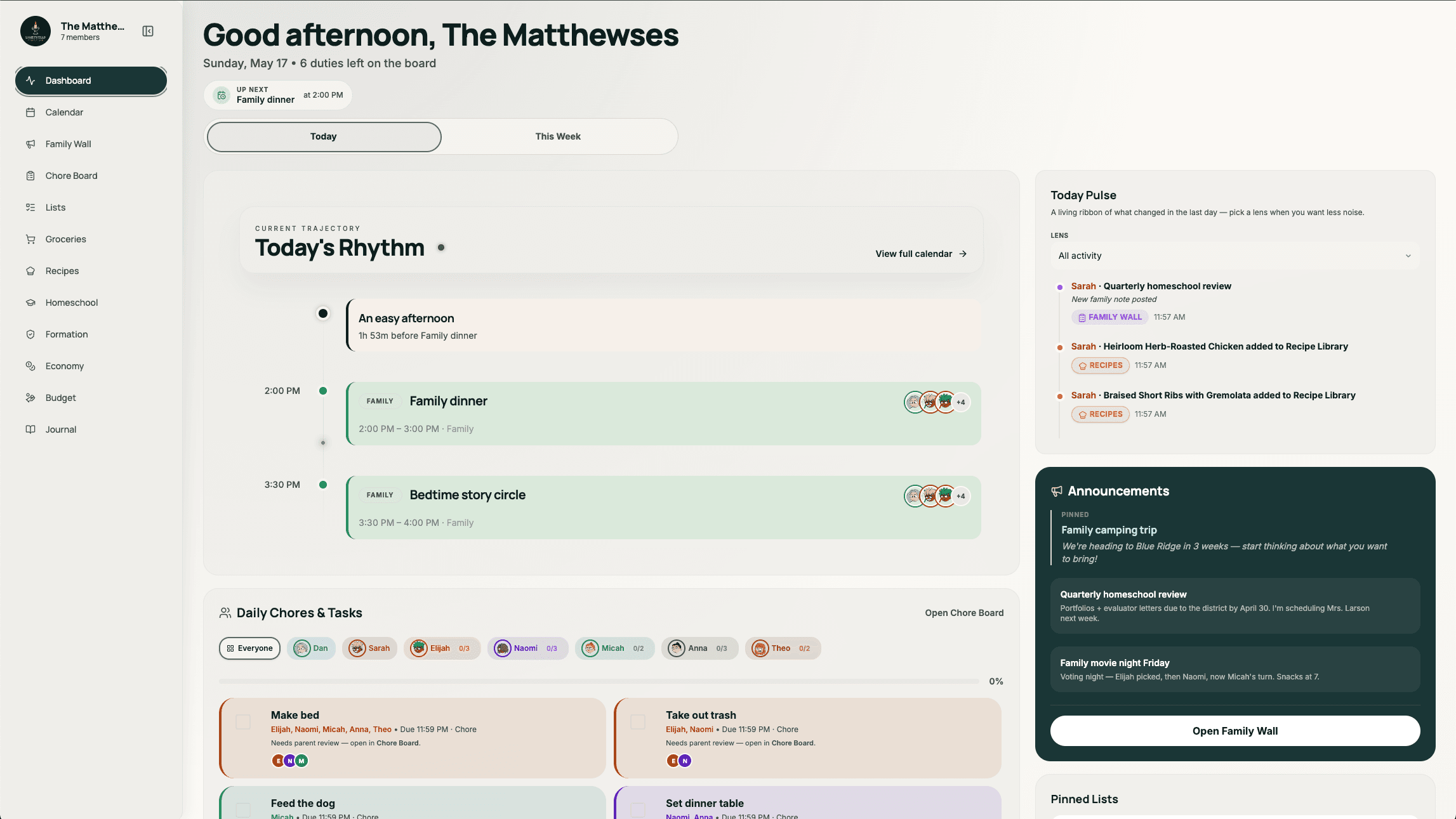
§4
Attendance, results, and immunization — retained.
Colorado tells home-based families to retain three categories of record: attendance records, the results of each standardized test or qualified-evaluator evaluation, and immunization records. These are kept by the family rather than filed routinely with the district, but they are the documentation that backs the notice and the assessment cadence. Keeping them together matters because the test/evaluation results connect to the consequence ladder and the attendance records connect to the 172-day, four-hour standard. A single, current packet means that if a question ever comes up, the proof is already assembled.
Colo. Rev. Stat. § 22-33-104.5
The records packet keeps attendance, test and evaluation results, and immunization records together in one place, and the transcript builder turns the same coursework into a record you can hand to a college later. Nothing is filed for you, but everything Colorado asks you to retain stays assembled.
Records packet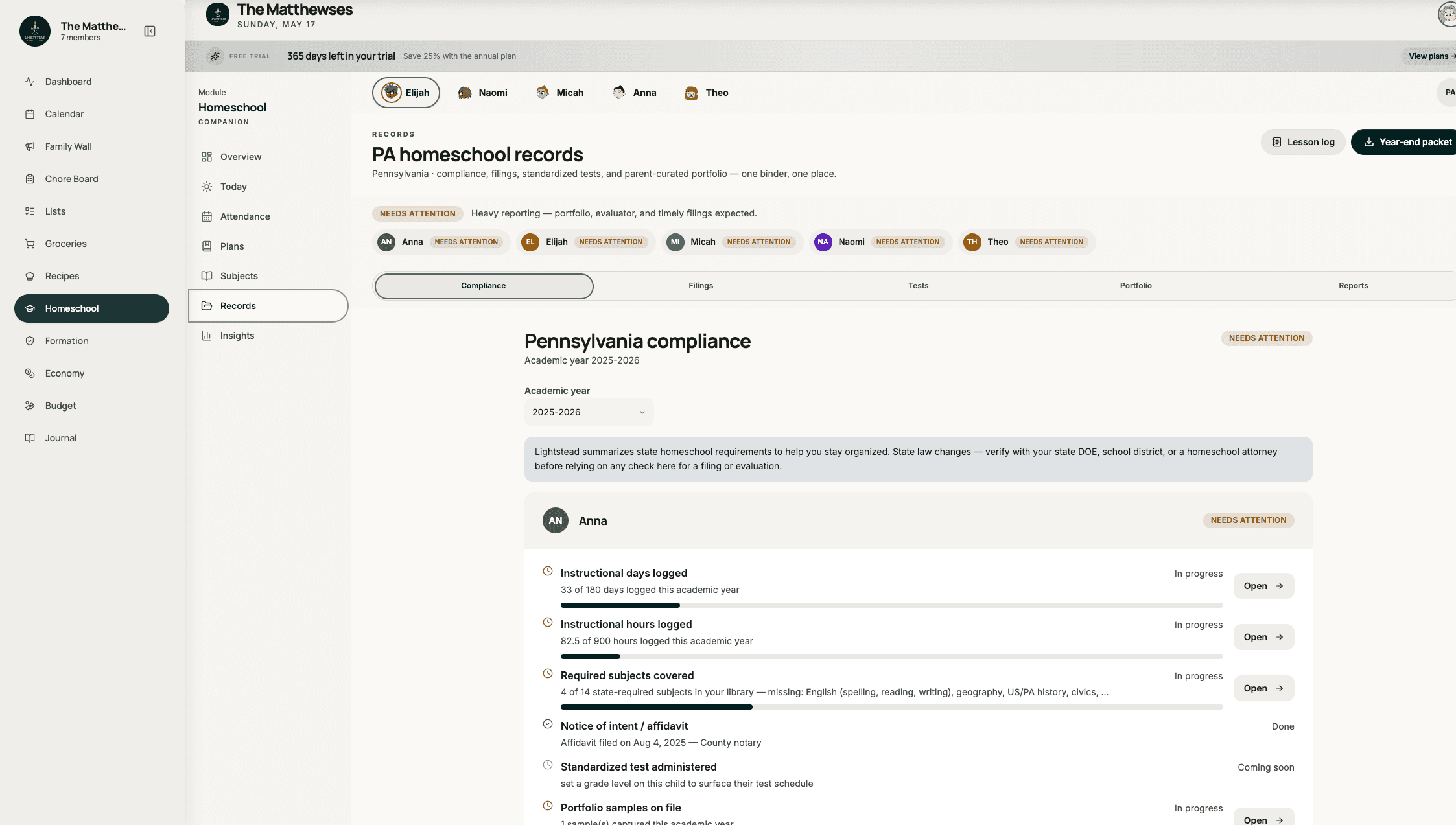
§5
A third route — no notice, no testing.
Colorado's third pathway is instruction by a Colorado state-certified teacher. When a state-certified teacher provides the instruction, the program carries no notice requirement and no assessment requirement — the notice-14-days-before, annual renewal, and grade 3/5/7/9/11 testing rules of the notice pathway do not apply. This pathway is narrower than the main one because it depends on a certified teacher actually delivering the instruction, but for families who qualify it removes the district-facing cadence entirely. The 172-day standard and the recordkeeping habits still make sense as good practice even where the statute's notice and testing steps fall away.
Colo. Rev. Stat. § 22-33-104.5
Families on the certified-teacher pathway use Lightstead for internal records and transcripts rather than district filings — there's no notice or score to track. The subjects list and daily lesson log still capture what was taught, so the record is there when it's useful.
Subjects & lesson log
What people search for when they look up Colorado homeschooling.
When do I have to notify the district to homeschool in Colorado?
Written notice goes to a school district superintendent 14 days before the home-based program starts, and then annually after that. The notice may be sent to any district superintendent, and certified mail is recommended so you keep proof of the date.
What does the Colorado homeschool notice have to include?
Each child's name and age, your place of residence, and the hours of attendance for the program. There is no curriculum approval — the notice simply records that the child is in a home-based program under Colo. Rev. Stat. § 22-33-104.5.
How many days and hours does Colorado require?
172 days of instruction, averaging four hours per day across the program. Because it's an average, longer and shorter days balance out, so the standard accommodates field trips and varied schedules without a fixed clock for each day.
What grades require testing in Colorado?
Grades 3, 5, 7, 9, and 11. In each of those grades a child in the notice-and-assessment pathway either takes a nationally-normed standardized test scoring above the 13th percentile or is reviewed by a qualified evaluator.
What happens if my child scores below the 13th percentile?
The child may retake the test using an alternate version. If the retest is still below the 13th percentile, the child must enroll in school until the next test period. The threshold applies only at grades 3, 5, 7, 9, and 11.
Can I use a qualified evaluator instead of a test in Colorado?
Yes. At each assessment grade you can choose a review by a qualified evaluator in place of the nationally-normed standardized test. Either option satisfies the assessment requirement for that grade's test period.
Do I have to send my child's test scores to the district every year?
No. Colorado has you retain attendance records, test or evaluation results, and immunization records yourself rather than filing them routinely. The annual step that goes to a superintendent is the renewal notice, not the scores.
What records do I have to keep to homeschool in Colorado?
Three categories: attendance records, the results of each standardized test or qualified-evaluator evaluation, and immunization records. Keeping them together means the attendance log backs the 172-day standard and the results connect to the assessment cadence.
Is there a way to homeschool in Colorado without testing or notice?
Yes — the third pathway, instruction by a Colorado state-certified teacher, has no notice requirement and no assessment requirement. The notice-14-days-before, annual-renewal, and grade 3/5/7/9/11 testing rules apply to the notice pathway, not this one.
Which superintendent do I send the Colorado notice to?
Any school district superintendent — it does not have to be the district where you live. Certified mail is recommended so you have a dated record that the notice was sent.
Related state guides
Stop tracking Colorado compliance in a spreadsheet.
14-day free trial. No credit card. We'll set up your filings, your hour log, and a portfolio starting point for Colorado.
Start free trial