
Homeschooling in Utah— one notice, then nothing — and the district can't ask for your records.
Utah is one of the lightest-touch homeschool states in the country. You file a single, one-time Notice of Intent with your local school board and the board acknowledges receipt — and that's the whole filing obligation. HB 209 (effective May 7, 2025) replaced the old excuse-certificate and affidavit process with this simple notice: no required subjects, no minimum days or hours, no teacher qualifications, and no testing. The law even bars school boards from requiring you to keep records of instruction or attendance, leaving curriculum and materials entirely to you. Little is required, but a college, a move, or a return to school will want a record someday — Lightstead keeps that record so it exists when you need it.
What Utah requires, at a glance.
- Notice
One-time NOI
A single Notice of Intent filed once with the local school board; the board must acknowledge receipt. HB 209 (effective May 7, 2025) replaced the former affidavit / excuse-certificate process.
- Cadence
File once
Not annual. The Notice of Intent is filed one time — there is no yearly renewal or re-filing requirement under Utah Code § 53G-6-204.
- Days / hours
None set
Utah sets no minimum number of instructional days or hours. There is no day count and no hour count to meet.
- Subjects
Parent's choice
No state-required subjects. The parent has sole responsibility for selecting curriculum and materials.
- Assessment
None required
No assessment, evaluation, or standardized testing requirement of any kind.
- Teacher qualification
None required
Utah imposes no teacher qualification or parent-credential requirement to homeschool.
- Records
District can't require
School boards are expressly prohibited from requiring parents to maintain records of instruction or attendance (Utah Code § 53G-6-204). Any records you keep are for your own use.
- Board response
Acknowledges receipt
After you file, the local school board must acknowledge receipt of your Notice of Intent — your proof the filing is on record.
§1
One Notice of Intent — filed once, acknowledged once.
Utah requires a single, one-time Notice of Intent filed with the local school board, after which the board must acknowledge receipt of the notice. There is no annual renewal: once the notice is on file and acknowledged, the filing obligation is satisfied. HB 209, effective May 7, 2025, replaced Utah's former excuse-certificate and affidavit-with-criminal-background process with this straightforward notice of intent. The board's acknowledgement is the artifact that matters — it is your evidence that the notice is on record. Keep the acknowledgement somewhere durable; because the filing happens only once, it can be hard to reproduce years later when a school, a college, or a new district asks whether you complied.
Utah Code § 53G-6-204(5)
Because the Notice of Intent is filed only once, Lightstead's filing wizard pre-fills your children's data, outputs a notice ready for the local school board, and then stores both the notice and the board's acknowledgement so you can produce them years later. The wizard marks the filing complete rather than putting a recurring deadline on your dashboard.
Notice of Intent wizard
§2
No subjects, no hours, no testing — nothing prescribed.
Beyond the one-time notice, Utah prescribes almost nothing. There are no required subjects, no minimum number of instructional days or hours, no teacher qualifications, and no assessment or standardized testing requirement. The parent holds sole responsibility for selecting curriculum and materials. That freedom is the point of Utah's law, and it is real — but it also means no external structure tells you whether the year added up. The decisions about scope, sequence, and pace are entirely yours, which makes your own plan and your own log the only place the shape of the year is recorded.
Utah Code § 53G-6-204
With no state-prescribed subjects, Lightstead's subjects and curriculum list lets you lay out exactly the course of study you choose — core academics, electives, faith, life skills — and use it as the backbone for the year. Nothing here is filed with Utah; it exists so you have a coherent plan and, later, a record of what was actually taught.
Subjects & curriculum list
§3
The district can't require records — so keep them for yourself.
Utah goes a step further than most light-touch states: school boards are expressly prohibited from requiring parents to maintain records of instruction or attendance. No district may demand your lesson logs, your hours, or proof of attendance. That prohibition removes an obligation, not a need. The same record a district cannot demand is the record a college admissions office, a future school district after a move, or a return to public school will eventually ask you to produce — and by then the day-to-day detail is gone unless you captured it as you went. Keeping a daily lesson log and a portfolio is voluntary in Utah, but it is the version of the year your future self can actually hand over.
Utah Code § 53G-6-204
Lightstead's daily lesson log and records packet give you the documentation Utah never makes you keep, organized for the moment someone else asks. The lesson log captures what was covered day to day, and the portfolio packet pulls work samples together — so a voluntary record is still a clean, retrievable one.
Daily lesson log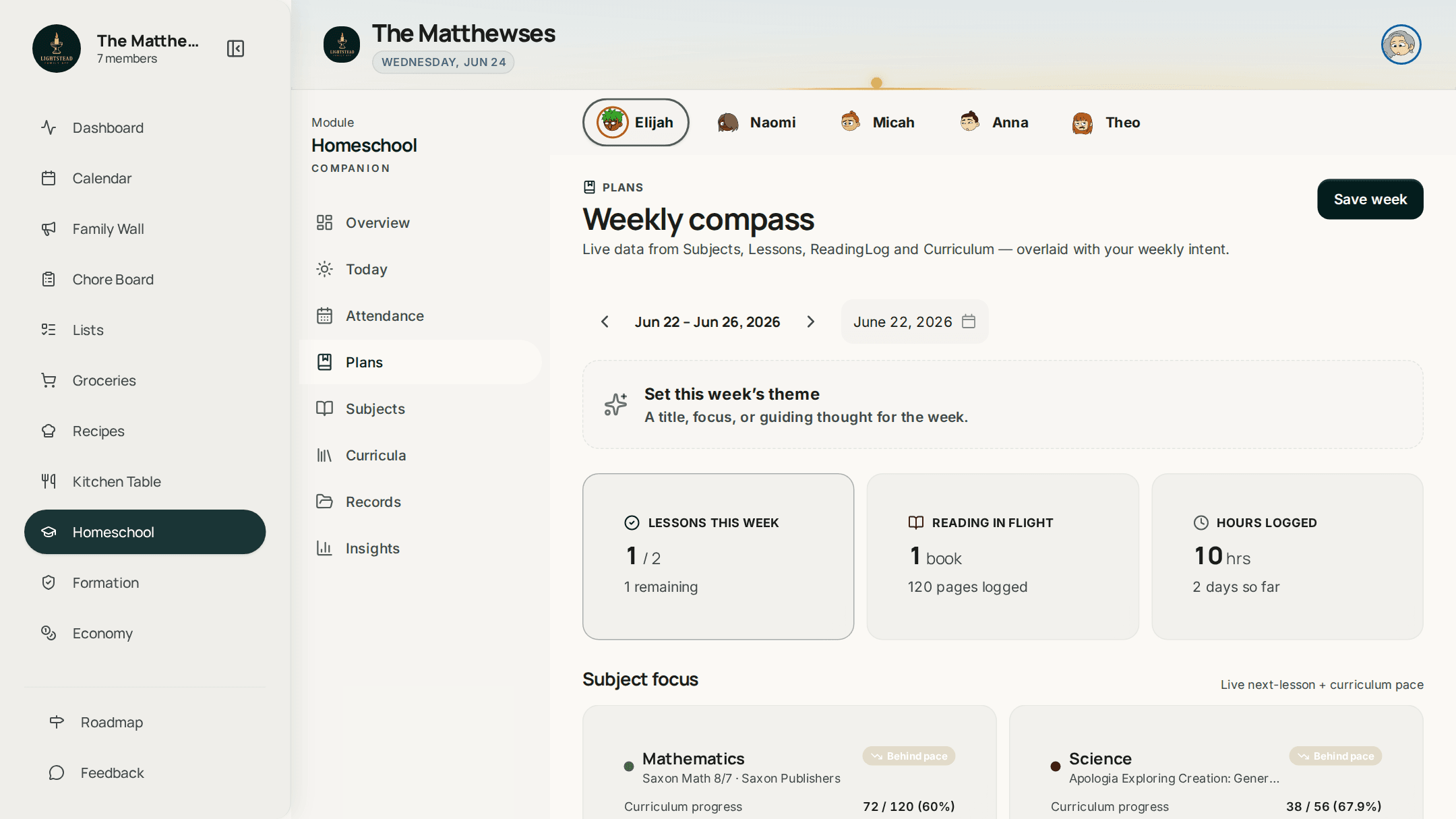
§4
Transcripts and a portfolio for college, a move, or a return.
Utah asks for no end-of-year evidence and no transcript, but the practical realities of homeschooling outlast the filing. A high-school transcript, course descriptions, and a portfolio of work are what colleges, scholarship programs, and out-of-state districts request — none of which Utah generates for you. Because the state keeps no academic record on your behalf, the transcript and portfolio you build are the only durable account of the work. For high school especially, assembling that record as you go is far easier than reconstructing four years of coursework from memory when an application deadline arrives.
Utah Code § 53G-6-204
Lightstead's transcript builder turns your subjects and logged coursework into a clean high-school transcript, and the records packet assembles the supporting portfolio. Utah won't ask for either, but when a college or a new district does, the document is already built instead of reconstructed under a deadline.
Transcript builder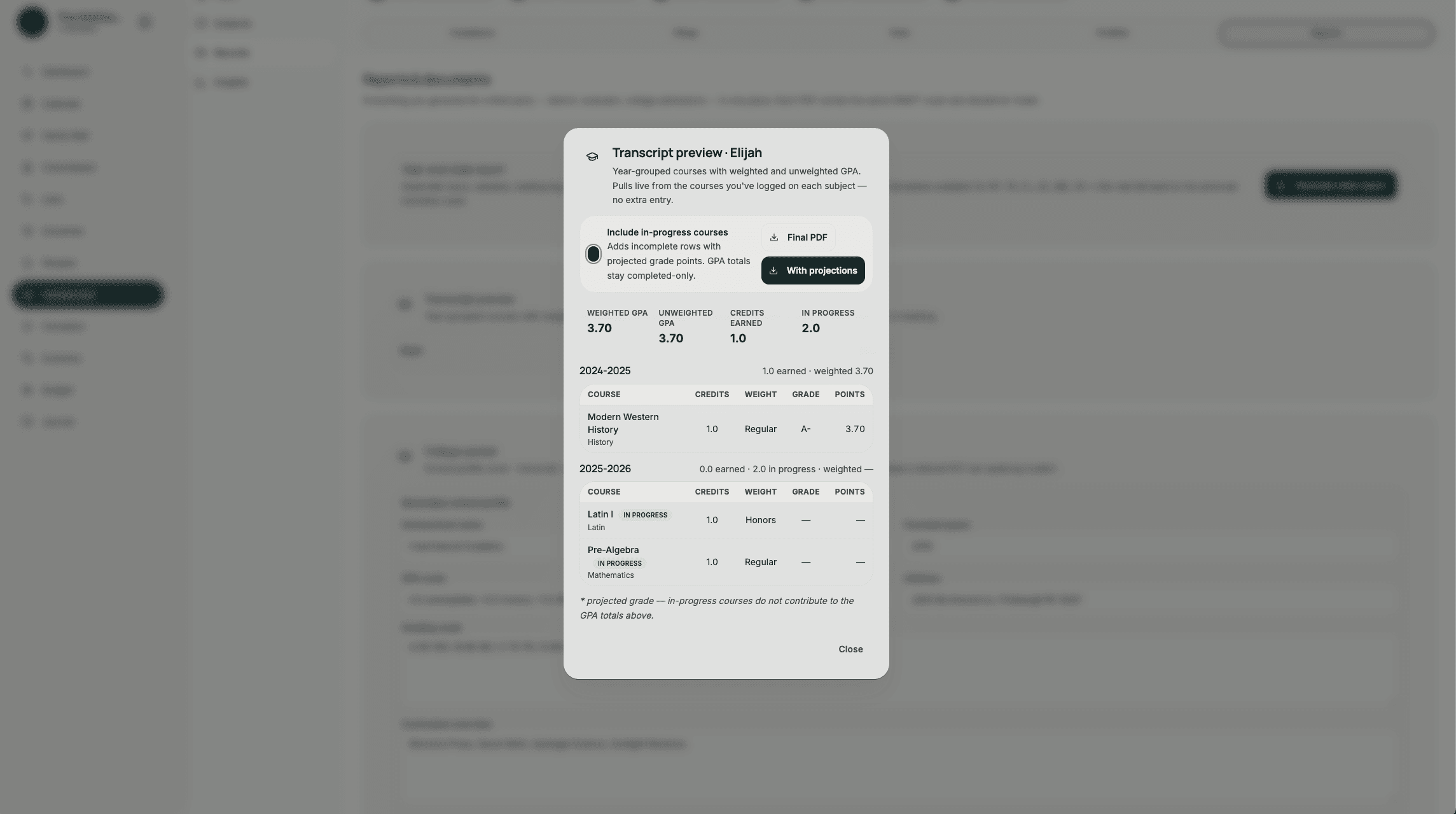
What people search for when they look up Utah homeschooling.
Do I have to register my homeschool in Utah?
You file a one-time Notice of Intent with your local school board, and the board acknowledges receipt — that single filing is the whole registration obligation. It is not annual; once the notice is on file and acknowledged under Utah Code § 53G-6-204, there is nothing further to submit.
Do I have to notify anyone before homeschooling in Utah?
Yes, once. You submit a one-time Notice of Intent to the local school board, which must acknowledge receipt. HB 209 (effective May 7, 2025) replaced Utah's former excuse-certificate and affidavit process with this simple notice — there is no yearly re-filing.
How often do I file the Utah homeschool notice?
Only once. Utah's Notice of Intent is a one-time filing, not an annual one. After the local school board acknowledges receipt, there is no renewal or re-submission requirement.
How many hours or days does Utah require for homeschooling?
None. Utah sets no minimum number of instructional days or hours. There is no day count and no hour count to meet — the pace and schedule are entirely the parent's to set.
Does Utah require homeschool testing?
No. Utah has no assessment, evaluation, or standardized testing requirement for homeschoolers. Nothing is submitted to the state and no outside test is mandated.
What subjects does Utah require homeschoolers to teach?
None are prescribed. Utah requires no specific subjects; the parent has sole responsibility for selecting curriculum and materials, including scope and sequence.
Do I need a teaching degree to homeschool in Utah?
No. Utah imposes no teacher qualification or parent-credential requirement. Any parent may homeschool after filing the one-time Notice of Intent.
Do I have to keep attendance or records to homeschool in Utah?
No — and the law goes further: school boards are expressly prohibited from requiring parents to maintain records of instruction or attendance under Utah Code § 53G-6-204. Any records you keep are voluntary and for your own use, such as a future college application or a move.
What changed with Utah homeschool law in 2025?
HB 209, effective May 7, 2025, replaced Utah's former excuse-certificate and affidavit-with-criminal-background process with a simple one-time Notice of Intent. The practical effect is a far lighter entry: file the notice once, receive the board's acknowledgement, and there are no subjects, hours, or testing requirements.
Does the school district acknowledge my Utah Notice of Intent?
Yes. Under Utah Code § 53G-6-204(5), the local school board must acknowledge receipt of your Notice of Intent. That acknowledgement is your proof the filing is on record — keep it, since the notice is filed only once.
Should I keep homeschool records even though Utah doesn't require them?
It's a good idea. Utah requires no records and bars the district from demanding them, but a college, a return to public school, or a move to another state can all ask for evidence of the work. A daily lesson log, a portfolio, and a transcript are far easier to keep as you go than to reconstruct later.
Can my Utah homeschooler get into college without a state transcript?
Yes. Utah doesn't generate a transcript for you, so you build your own from your coursework. A clean homeschool transcript with course descriptions and a portfolio of work is what colleges and scholarship programs request — assembling it as you go makes admissions straightforward.
Related state guides
Stop tracking Utah compliance in a spreadsheet.
14-day free trial. No credit card. We'll set up your filings, your hour log, and a portfolio starting point for Utah.
Start free trial