
Homeschooling in Hawaii— one-time notice to the principal, then testing in grades 3, 5, 8, and 10.
Hawaii is a file-once state. You send a one-time notice — DOE Form 4140 or a signed letter — to the principal of the school your child would otherwise attend before you begin, and again when you stop. There is no minimum number of days or hours and no required subject list, but you must keep a curriculum record, and your child takes a standardized test in grades 3, 5, 8, and 10 to show grade-level achievement. In every other grade you pick from five assessment options. Lightstead files the notice, keeps the curriculum record the rule describes, and surfaces the testing-grade years before they arrive.
What Hawaii requires, at a glance.
- Notice
One-time
A single initial notice to the principal of the school your child would otherwise attend, sent before you begin — plus a notice when you stop homeschooling.
- Notice form
Form 4140 or letter
DOE Form 4140, or a letter with the child's name, address, phone, date of birth, grade level, and the parent's signature.
- Days / hours
Not specified
No minimum number of instructional days or hours. The curriculum record and the testing grades are the proof artifacts, not a day count.
- Subjects
None required
No state-prescribed subjects. The curriculum must be structured, cumulative, sequential, and age-appropriate, but the parent chooses scope and content.
- Testing grades
3, 5, 8, 10
In grades 3, 5, 8, and 10 the child takes a criterion- or norm-referenced standardized test demonstrating grade-level achievement.
- Other grades
5 options
In every other grade, pick one of five: normed test at grade level, normed test showing a year's progress, certified-teacher evaluation, parent evaluation with work samples, or Hawaii Statewide Testing Program results.
- Records
Curriculum record
Start/end dates, weekly hours, subjects covered, the method used to determine mastery, and a bibliographic list of materials — kept by the family.
- Teacher qualification
None required
Hawaii sets no teacher-qualification requirement. Any parent may direct the home instruction.
§1
File once with the principal — and again only when you stop.
Before you begin home instruction, Hawaii requires an initial notice to the principal of the public school your child would otherwise attend. You can use the Department of Education's Form 4140 or send a letter carrying the same information: the child's name, address, phone number, date of birth, grade level, and your signature as the parent. This is a one-time filing, not an annual one. The only follow-up the rule requires is a second notice to the principal when you are no longer homeschooling — for example, when the child returns to a public or private school or finishes school. There is nothing to renew each August.
Haw. Admin. Rules § 8-12; HRS § 302A-1132(a)(5)
Lightstead's filing wizard builds the Hawaii notice from your children's profiles — name, address, phone, date of birth, and grade — into a Form 4140-style document ready for the principal, and records that you have filed so the dashboard stops prompting. Because the notice is one-time, the wizard also keeps the stop-homeschooling notice on hand for when you need it.
Hawaii notice wizard
§2
The record the rule names — keep it as you go.
Hawaii requires parents to maintain a record of the curriculum. The rule is specific about what it contains: the start and end dates of instruction, the number of hours spent each week, the subjects covered, the method used to determine mastery of the material, and a bibliographic list of the instructional materials used. This record is kept by the family, not filed with the state. It works alongside the curriculum standard itself — instruction must be structured, cumulative, sequential, and age-appropriate — but Hawaii does not prescribe any particular subjects or set a minimum number of days or hours. The record is what demonstrates the program existed and what it covered.
Haw. Admin. Rules § 8-12
Lightstead's curriculum list and daily lesson log together capture exactly what the rule asks for: start and end dates, weekly hours, the subjects covered, your mastery method, and the materials you used. The lesson log accumulates the weekly hours automatically, and the subjects list doubles as the bibliographic materials record — so the curriculum record builds itself as you teach.
Subjects & curriculum list
§3
Grades 3, 5, 8, and 10 — show grade-level achievement.
In grades 3, 5, 8, and 10, Hawaii requires the child to take a standardized test. The test must be a criterion-referenced or norm-referenced instrument that demonstrates the child is achieving at grade level. These four checkpoints are the fixed assessment years. The test is part of the records the family keeps; nothing about it changes the one-time nature of the notice. The grade milestones are spaced out — roughly every two to three years — so most families only have a handful of testing years across a full K-12 program, and they are known years in advance.
Haw. Admin. Rules § 8-12
Lightstead knows each child's grade, so the testing years — 3, 5, 8, and 10 — show up on the dashboard as deadline-style cards well before they arrive, instead of catching you by surprise. When the test is done, the score attaches to the same records as your curriculum record and assessments.
Testing years on your dashboard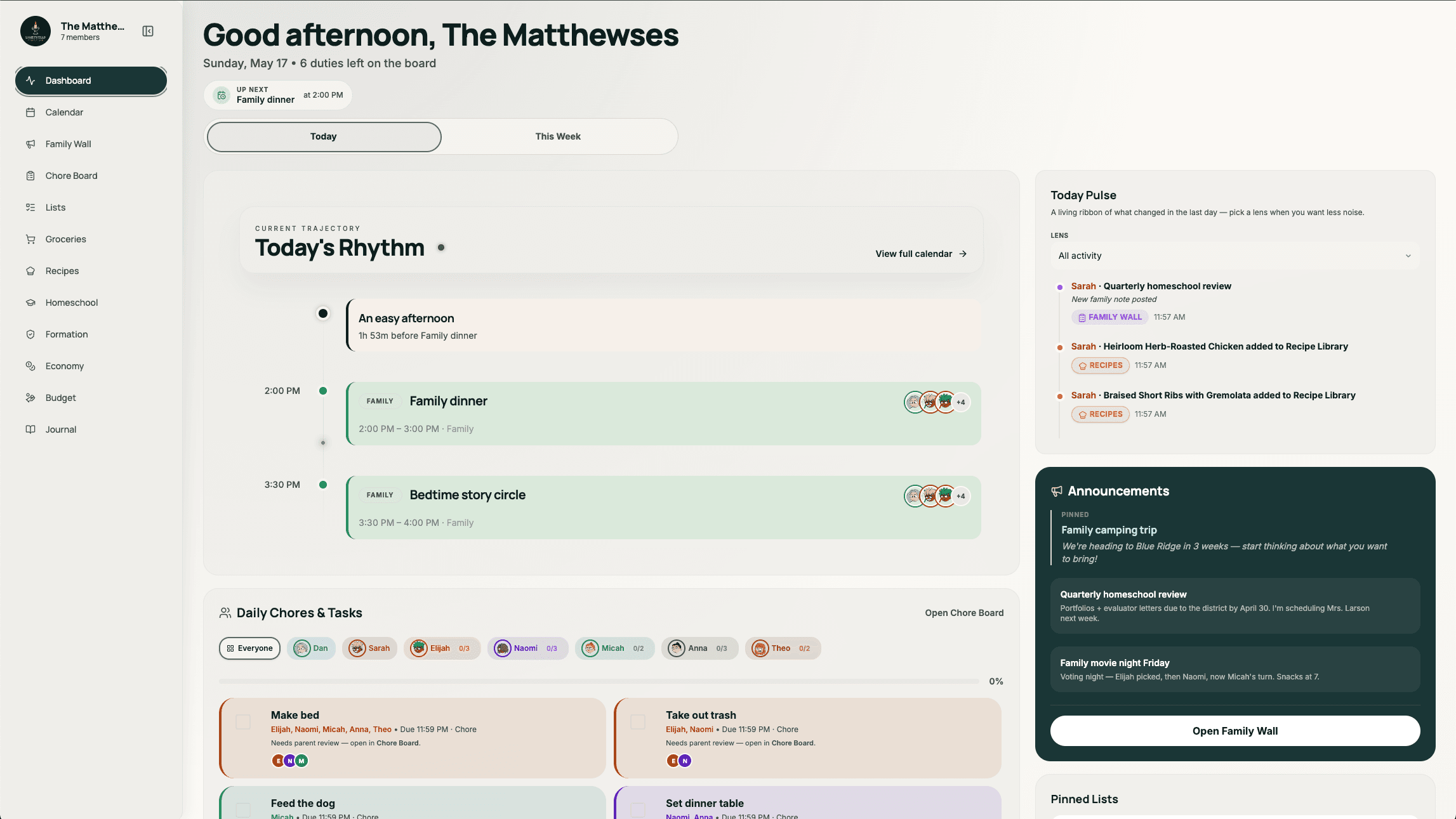
§4
Off a testing year? Pick one of five assessment options.
For every grade that is not 3, 5, 8, or 10, Hawaii lets the family satisfy assessment with one of five options: (1) a nationally normed standardized test taken at grade level; (2) a nationally normed standardized test showing at least one grade level of progress per calendar year; (3) a written evaluation by a Hawaii-certified teacher; (4) a written progress evaluation by the parent, accompanied by work samples and a record of assignments; or (5) the results of the Hawaii Statewide Testing Program. The parent-written evaluation with work samples (option 4) is the route most families use in off-years because it relies on the work the child is already producing rather than an outside test. The five options give you a low-friction way to document progress in the years between the fixed testing grades.
Haw. Admin. Rules § 8-12
If you choose the parent-written evaluation with work samples, Lightstead has the pieces in one place: the daily lesson log records the assignments, the portfolio packet collects the work samples, and you write the progress evaluation against them. If you opt for a test or a certified-teacher evaluation instead, the result attaches to the same records.
Records & portfolio packet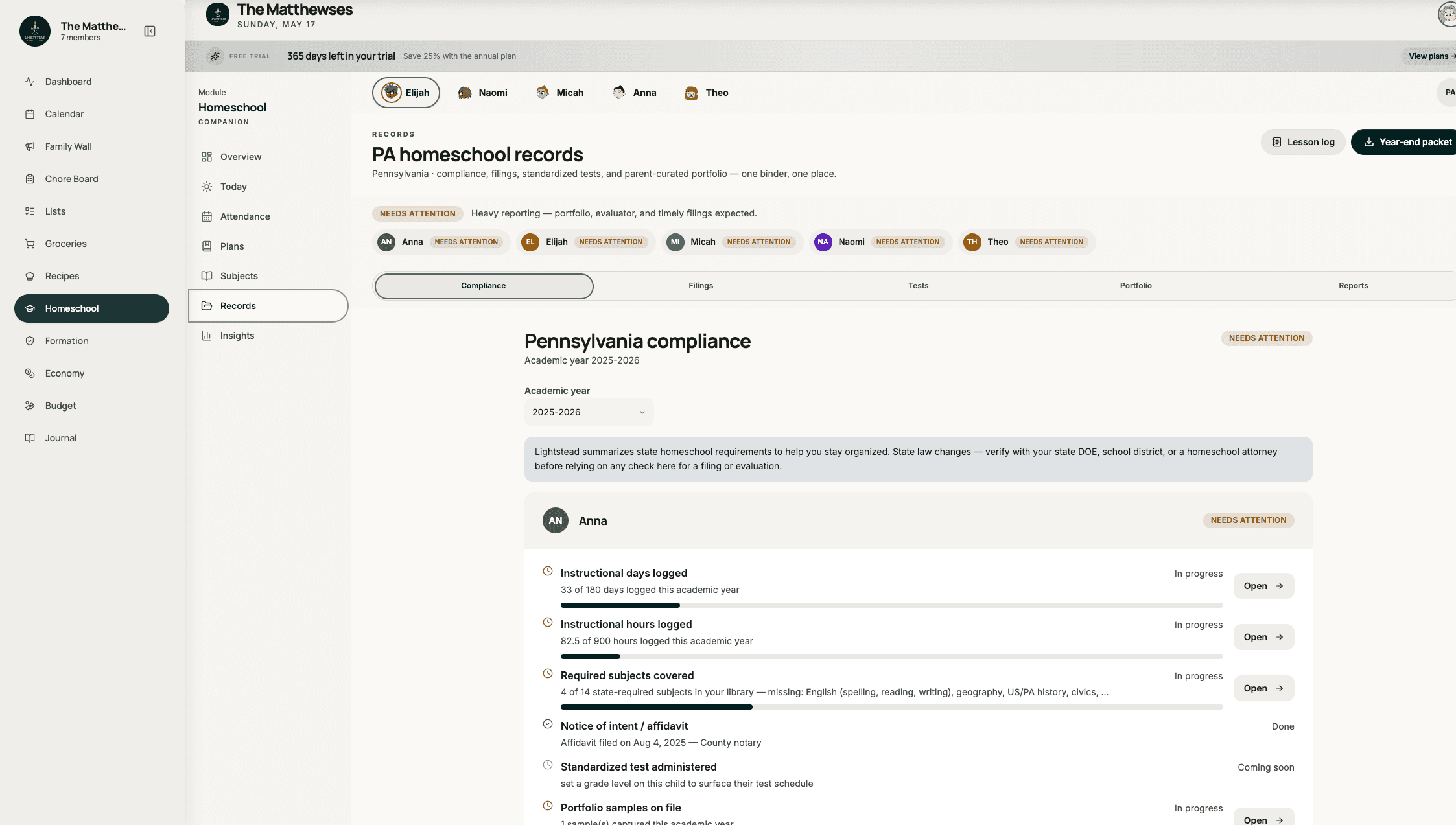
What people search for when they look up Hawaii homeschooling.
Do I have to register my homeschool in Hawaii?
You file a one-time notice, not a registration. Before you begin, you send an initial notice — Form 4140 or a signed letter with the child's name, address, phone, date of birth, and grade — to the principal of the school your child would otherwise attend. It is not renewed annually; the only other notice required is one when you stop homeschooling.
Do I have to notify anyone before I start homeschooling in Hawaii?
Yes. Hawaii requires an initial notice to the principal of the public school your child would otherwise attend, sent before home instruction begins. You can use DOE Form 4140 or a letter carrying the same information, signed by the parent.
Does Hawaii require homeschool testing?
Yes, but only in specific grades. In grades 3, 5, 8, and 10 the child takes a criterion- or norm-referenced standardized test demonstrating grade-level achievement. In every other grade you choose one of five assessment options instead.
What are the five assessment options in Hawaii?
For grades other than 3, 5, 8, and 10: (1) a nationally normed test at grade level; (2) a nationally normed test showing at least one grade level of progress per calendar year; (3) a written evaluation by a Hawaii-certified teacher; (4) a parent-written progress evaluation with work samples and a record of assignments; or (5) Hawaii Statewide Testing Program results.
How many hours or days does Hawaii require for homeschooling?
Hawaii sets no minimum number of instructional days or hours. The curriculum record does ask you to note the hours spent each week, but there is no statewide day count or hour total to hit — the testing grades and the curriculum record are what document the program.
What records do I have to keep to homeschool in Hawaii?
A record of the curriculum that includes the start and end dates of instruction, the number of hours spent each week, the subjects covered, the method used to determine mastery, and a bibliographic list of the instructional materials used. The record is kept by the family, not filed with the state.
What subjects does Hawaii require homeschoolers to teach?
Hawaii does not prescribe any specific subjects. The rule requires that the curriculum be structured, cumulative, sequential, and age-appropriate, but the parent chooses the subjects, scope, and materials.
Do I need a teaching certificate to homeschool in Hawaii?
No. Hawaii sets no teacher-qualification requirement for homeschooling parents. One of the five assessment options does involve an evaluation by a Hawaii-certified teacher, but that is a choice for off-year assessment, not a requirement to teach.
How often do I file paperwork to homeschool in Hawaii?
Once, at the start. The initial notice to the principal is a one-time filing — there is nothing to renew each year. The only additional notice the rule requires is one to the principal when you are no longer homeschooling.
What happens in Hawaii in the years between the testing grades?
In any grade that is not 3, 5, 8, or 10, you satisfy assessment with one of the five options rather than the standardized test. Many families use the parent-written progress evaluation with work samples in those off-years, because it draws on the work the child is already producing.
Do I need to notify the school when I stop homeschooling in Hawaii?
Yes. Just as you notify the principal before you begin, the rule requires you to notify the principal when you are no longer homeschooling — for example, when the child returns to a public or private school or finishes school.
Related state guides
Stop tracking Hawaii compliance in a spreadsheet.
14-day free trial. No credit card. We'll set up your filings, your hour log, and a portfolio starting point for Hawaii.
Start free trial