
Homeschooling in Kansas— register once with the state — then teach, on your own records.
Kansas homeschools operate as non-accredited private schools, so there is no annual notice and no portfolio review. You register your school's name and address once with the Kansas State Board of Education — there is no renewal — and then teach for substantially the same period as the public schools, roughly 186 days of at least six hours. No subjects are prescribed, no testing is required, and the state keeps no record mandate. That last part is the catch: nothing forces a record to exist, so the records you keep are the ones your future self — a college, a move, a return to public school — will actually need. Lightstead keeps the attendance, subjects, and portfolio that the state never asks for but your family may.
What Kansas requires, at a glance.
- Registration
One-time
Register the school name and address once with the Kansas State Board of Education. No annual renewal and no annual notice.
- Days / hours
~186 days · 6 hrs
Instruction for substantially the same period as the public schools — roughly 186 days of at least six hours each.
- Legal status
Private school
Homeschools operate as non-accredited private schools under Kan. Stat. Ann. §§ 72-3120 and 72-4345–4347.
- Subjects
Not prescribed
No specific subjects are mandated by statute, but the instruction must be planned and scheduled rather than incidental.
- Instructor
‘Competent’
The teacher must be competent. KSDE has no authority to evaluate parental competency, so there is no credential to file.
- Testing
Not required
Periodic testing is recommended by KSDE but is not legally required. No score is reported to anyone.
- Records
None mandated
Kansas sets no record-keeping mandate. Whatever attendance, work, and progress you keep is for your own family, not the state.
§1
Register the school name once — there is no renewal.
Kansas does not have a homeschool statute in the usual sense. Instead, a homeschool operates as a non-accredited private school, and the only state-facing step is a one-time registration of the school's name and address with the Kansas State Board of Education. There is no annual notice, no renewal, and nothing to re-file as your children move up grades. That single registration is the whole filing. Once your school is on record, the state's involvement effectively ends — the obligations that remain (the school term and competent instruction) are things you do at home, not documents you submit.
Kan. Stat. Ann. §§ 72-3120, 72-4345 to 72-4347
Because Kansas has just one registration and no recurring filing, Lightstead opens your KS profile onto the school year itself rather than a filing queue. The dashboard records that your school is registered and then tracks the term and the days, so there's a card for what actually matters instead of a notice reminder you'll never see again.
Open your Kansas dashboard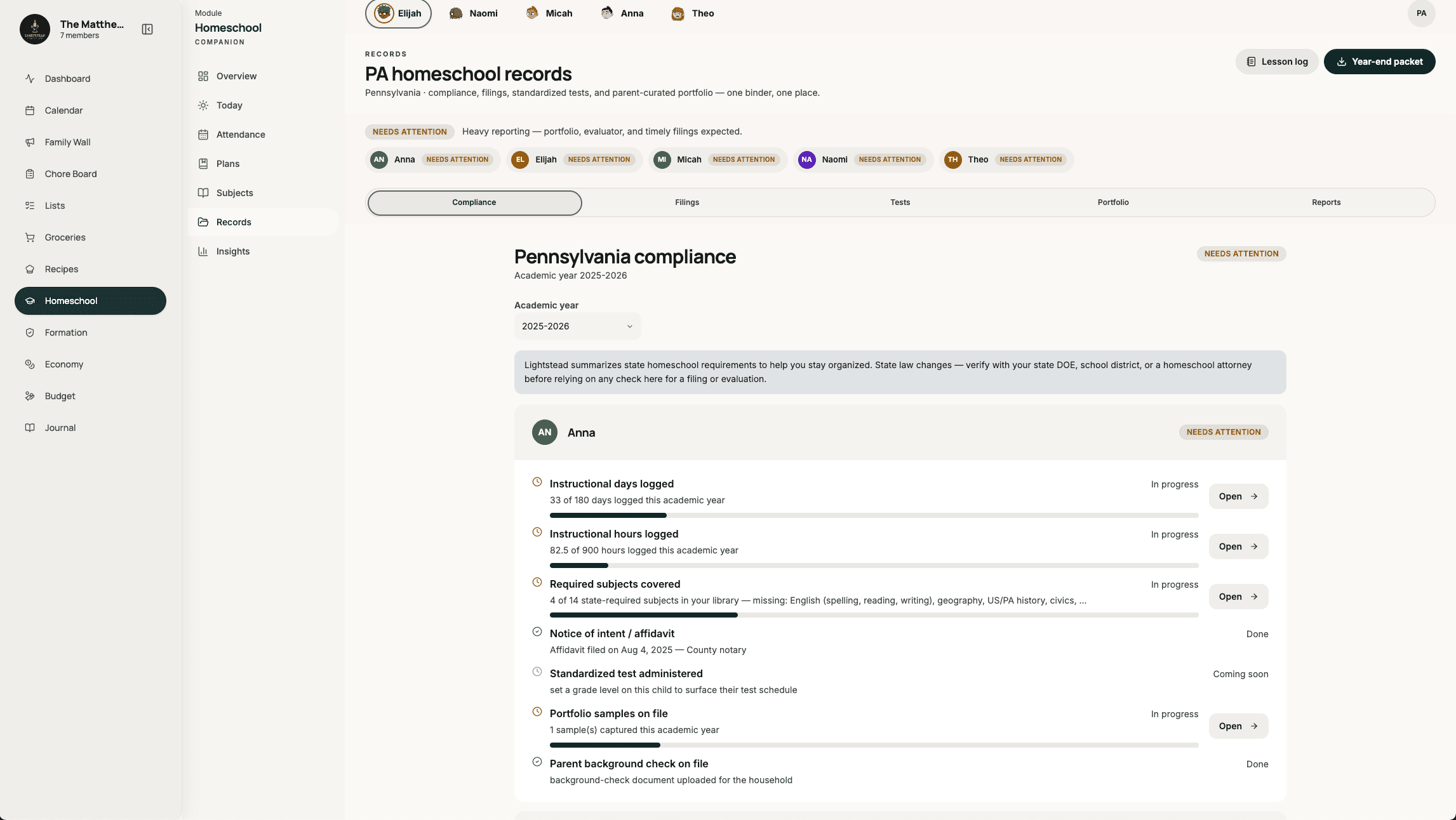
§2
Substantially the same period as the public schools.
As a non-accredited private school, a Kansas homeschool must provide instruction for substantially the same period of time as the public schools in its district. In practice this is read as roughly 186 days of at least six hours of instruction each — close to a standard public-school calendar — though the statute frames it as a comparison to the local district rather than a fixed number. There is no hour bank to fill and nothing to report; the requirement is simply that the school operates on a real, comparable schedule. The point of tracking days is your own evidence that the year was a school year, not a submission to the state.
Kan. Stat. Ann. §§ 72-3120, 72-4345 to 72-4347
Lightstead's attendance and hours log counts your school days and the hours within them, so you can see at a glance that the year lines up with the local public-school calendar. Nothing is filed, but if a question ever comes up the day count is already there rather than reconstructed from memory.
Attendance & hours log
§3
No required subjects — but the teaching must be planned.
Kansas prescribes no specific subjects. The family chooses the scope, the sequence, and the materials with no state-mandated course list. What the law does expect is that the instruction be planned and scheduled — a genuine, organized program of study rather than incidental learning. That distinction is the practical line a Kansas homeschool sits on: there is no curriculum to approve and no subject to prove, but there should be a plan behind the year. Keeping a subjects list and a lesson plan is how a planned-and-scheduled program looks from the inside.
Kan. Stat. Ann. §§ 72-3120, 72-4345 to 72-4347
Lightstead's subjects list lets you lay out the courses you'll teach, and the daily lesson log turns that into the planned-and-scheduled record the law expects. Neither is filed anywhere — together they're simply the evidence that the year was an organized program rather than improvised.
Subjects & curriculum list
§4
A competent teacher, and testing only if you want it.
The instructor in a Kansas homeschool must be competent. The statute does not define a credential, and the Kansas State Department of Education has no authority to evaluate a parent's competency — so there is no teaching certificate to hold and no review to pass. The standard is met by being the capable, engaged teacher your child's program needs. Testing follows the same light pattern. KSDE recommends periodic testing as good practice, but it is not legally required and no score is reported to the state or the district. Whether to test, and which test to use, is entirely the family's call.
Kan. Stat. Ann. §§ 72-3120, 72-4345 to 72-4347
If you do choose to test — KSDE recommends it even though Kansas doesn't require it — Lightstead's records packet is where the scores live alongside the year's work, so a recommended-but-optional test still produces a tidy artifact. If you skip testing, nothing is missing; the standard the law actually sets is just a competent teacher.
Records & portfolio packet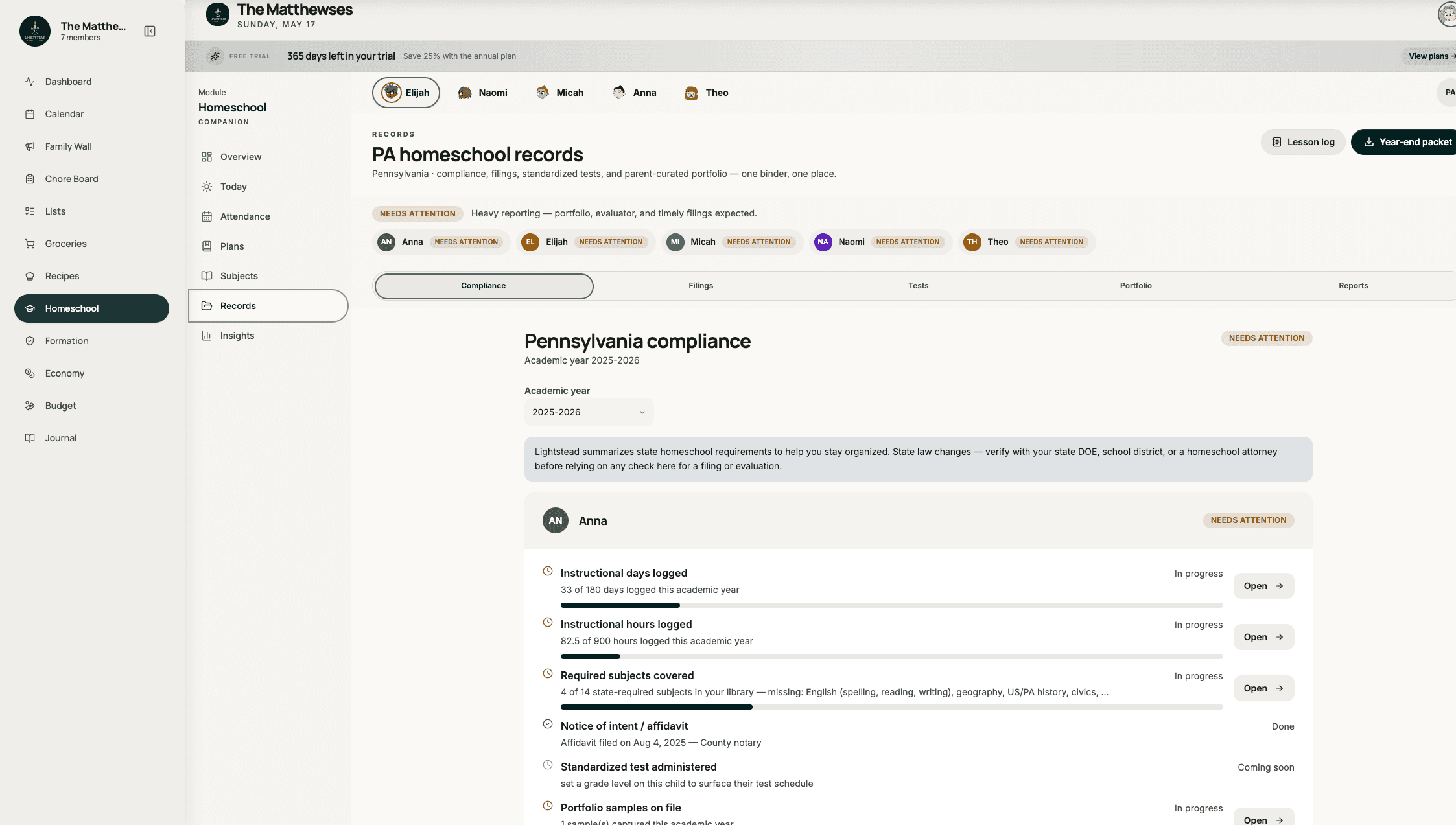
§5
Kansas mandates none — keep them for your future self.
Kansas imposes no record-keeping mandate on homeschools. There is no portfolio to assemble for the state, no attendance register to submit, and no progress report to file. On paper, a Kansas family could keep nothing at all. That is exactly why the records still matter. Nothing forces a record to exist, so when a college wants a transcript, a move means a new state with stricter rules, or a child returns to public school and needs a grade placement, the only documentation that exists is the documentation you chose to keep. The light-touch law is a reason to keep good records by choice, not a reason to keep none.
Kan. Stat. Ann. §§ 72-3120, 72-4345 to 72-4347
Lightstead keeps the record Kansas never asks for: the daily lesson log doubles as a plan book, work samples build a portfolio, and the attendance log shows the year happened — all retained for as long as you keep the account. The transcript builder turns the high-school years into a clean transcript when a college, a move, or a return to school finally needs one.
Transcript builder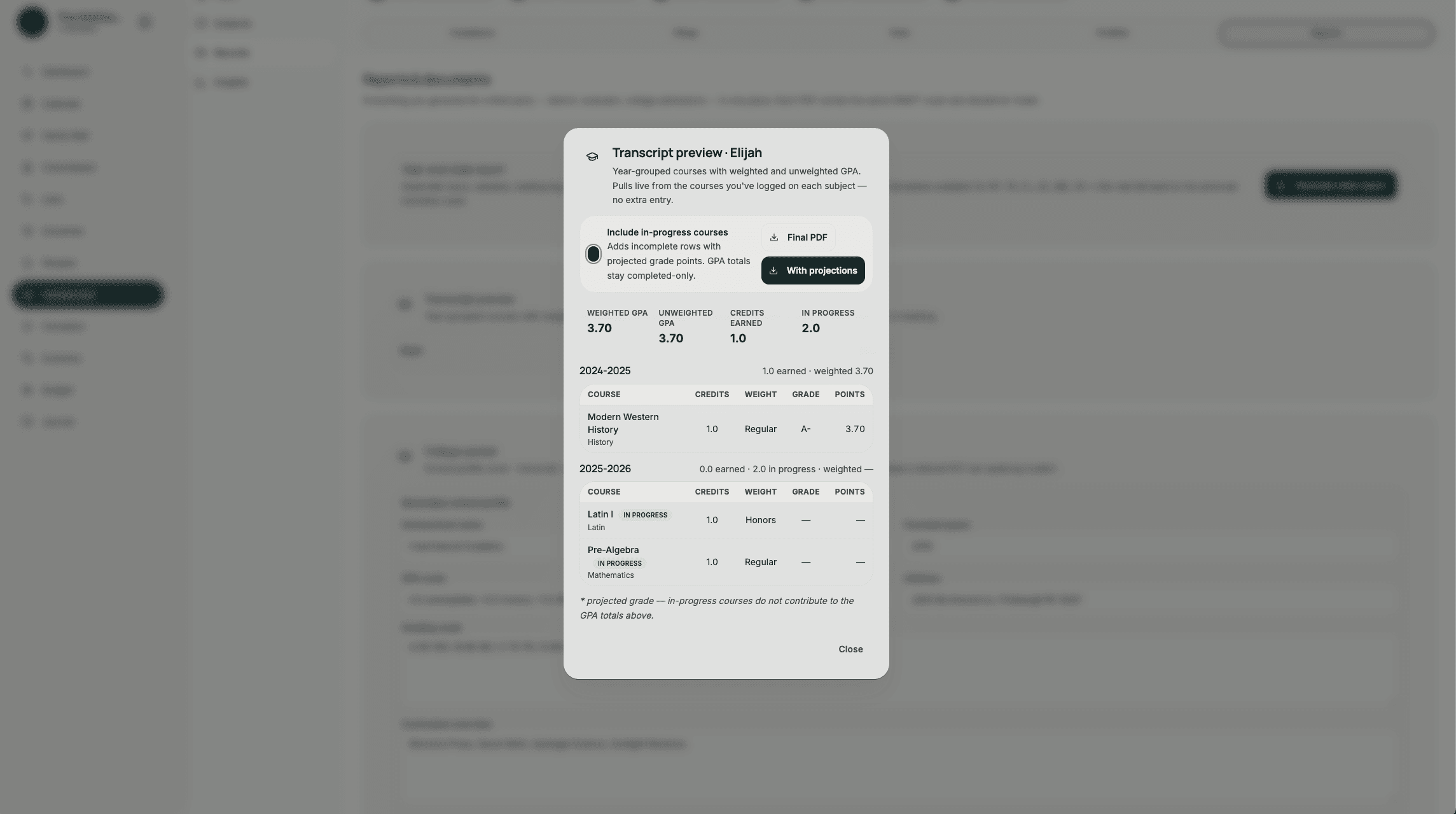
What people search for when they look up Kansas homeschooling.
Do I have to register my homeschool in Kansas?
Yes, but only once. A Kansas homeschool operates as a non-accredited private school, and the single state-facing step is a one-time registration of the school's name and address with the Kansas State Board of Education. There is no annual renewal and no annual notice after that.
Do I have to notify anyone every year to homeschool in Kansas?
No. After the one-time registration of your school name and address, Kansas requires no annual notice, no renewal, and no yearly report. Your involvement with the state effectively ends once the school is registered.
How many days does Kansas require for homeschooling?
Kansas requires instruction for substantially the same period as the public schools in your district — read in practice as roughly 186 days of at least six hours each. The statute frames it as a comparison to your local district rather than a fixed hour bank.
What subjects does Kansas require homeschoolers to teach?
None are mandated by statute. Kansas does not prescribe a subject list, scope, or sequence. The law does expect the instruction to be planned and scheduled — an organized program of study rather than incidental learning — but the curriculum is entirely your choice.
Does Kansas require homeschool testing?
No. The Kansas State Department of Education recommends periodic testing as good practice, but it is not legally required, and no score is reported to the state or your district. Whether to test, and which test to use, is entirely up to your family.
Do I need a teaching certificate to homeschool in Kansas?
No. The instructor must be competent, but Kansas does not define a credential, and KSDE has no authority to evaluate a parent's competency. There is no certificate to hold and no review to pass.
Does Kansas require me to keep homeschool records?
No. Kansas imposes no record-keeping mandate — there is no portfolio, attendance register, or progress report to keep for the state. That said, keeping records is strongly advisable, because nothing forces them to exist and you'll want them for a college application, a move to a stricter state, or a return to public school.
Is homeschooling legal in Kansas?
Yes. Kansas homeschools are legal as non-accredited private schools under Kan. Stat. Ann. §§ 72-3120 and 72-4345–4347. Once you register the school name and address and provide planned instruction by a competent teacher for a comparable school term, you are operating lawfully.
What records should I keep even though Kansas doesn't require them?
At minimum, an attendance log showing the school days, a subjects or curriculum list, samples of your child's work, and — for high school — the course records that become a transcript. Kansas asks for none of these, but they are the documentation a college, a new state, or a returning school will eventually want.
What happens to my Kansas homeschool records if we move to another state?
Many states require notice, attendance, or testing that Kansas does not. If you keep a clear attendance log, subjects list, and portfolio in Kansas, you arrive in the new state able to show the years already completed; if you kept nothing, you may have to reconstruct or restart that proof. The light Kansas law is a reason to keep records, not skip them.
Related state guides
Stop tracking Kansas compliance in a spreadsheet.
14-day free trial. No credit card. We'll set up your filings, your hour log, and a portfolio starting point for Kansas.
Start free trial